NORI
THE PROTAGONIST
THE MENTOR

ENFJ

The ENFJ personality type is characterized by a strong awareness of people’s potential and a desire to help it unfold. As one of the 16 Myers-Briggs personality types, ENFJs are guided by a purposeful vision that drives growth in both themselves and others. They naturally mentor, motivate, and organize their social environments in ways that encourage long-term personal development and progress.

EXTRAVERTED
INTUITION
FEELING
JUDGING
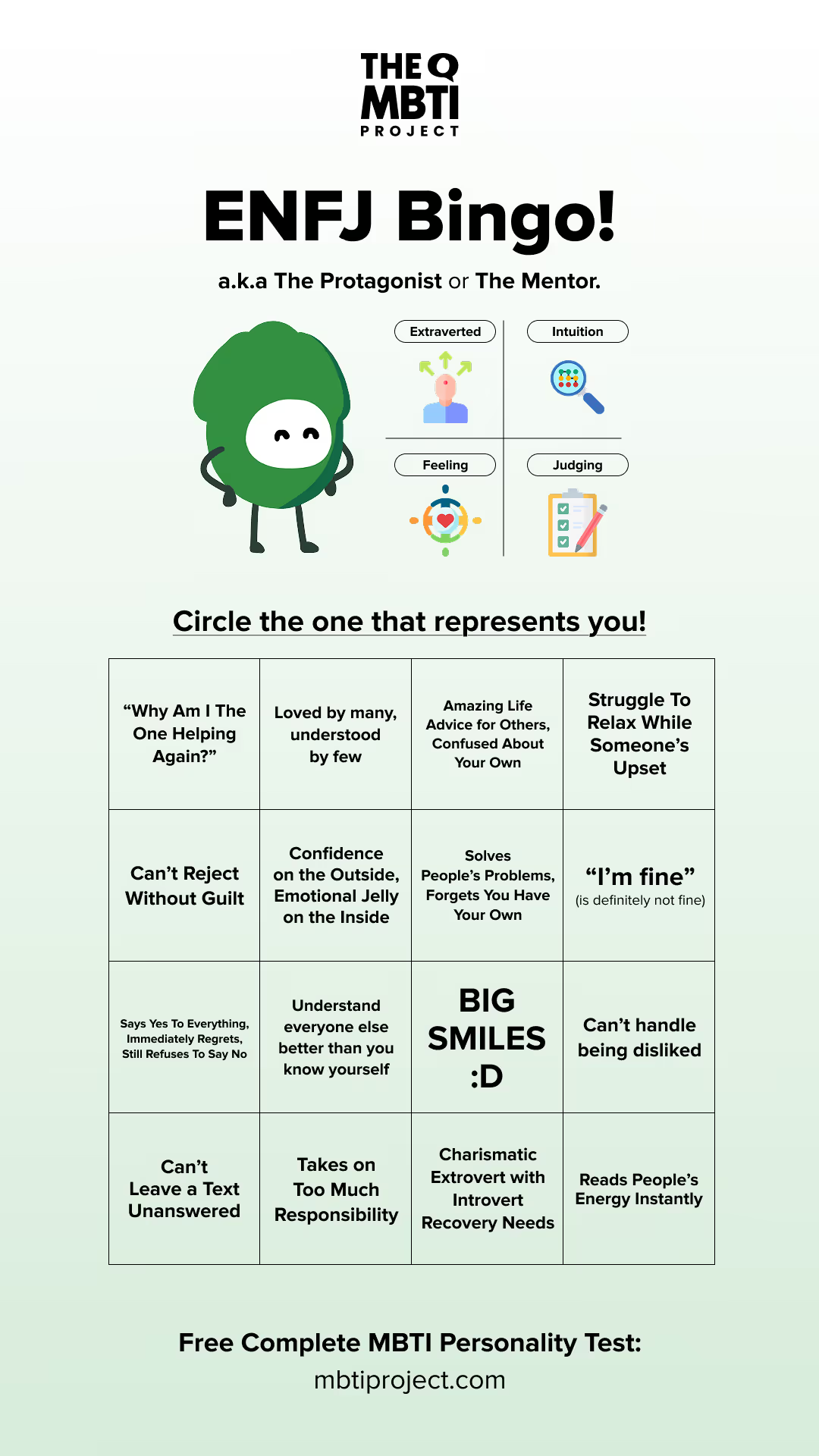
ENFJ BINGO!

Think you’re a real ENFJ?
Download this ENFJ Bingo, mark your squares, and post it on your Stories! Don’t forget to tag @thembtiproject. We’ll feature the best ones!

Download ENFJ Bingo

ENFJ Introduction

ENFJs are Extraverted (E), Intuitive (N), Feeling (F), and Judging (J) personalities who are naturally attuned to people’s emotions and social dynamics. They have the ability to guide people toward a purposeful direction with empathy and deep understanding.

ENFJs are often called the Protagonist or the Mentor because they know how to bring people together around shared values and purpose. ENFJs lead others through emotional alignment and encouragement. Their main strength lies in identifying untapped potential in others and helping them believe in those strengths themselves.

Sometimes, ENFJs could give so much that they forget where their responsibility ends. When they learn to care for themselves as deeply as they care for others, their impact becomes stronger and more sustainable.

UNFORTUNATELY ACCURATE:

ENFJs can’t relax when the group vibe is off. Even when it’s not their mess, they often feel obligated to clean it up (which is how they end up trapped in conflicts they never wanted).

Classic ENFJ Lines:

"It's fine... I'll handle it. Don't worry!"

"It seems that you don’t believe in yourself yet? That’s okay, I’ll believe for both of us."

“I feel like you should… [very good advice]”

ENFJ Strengths

1. Emotional & Social Intelligence

ENFJs instinctively read emotional dynamics and unspoken tension. They often sense how someone feels before it’s put into words, which makes people feel seen and understood.

2. Ability to See and Nurture Potential

ENFJs naturally see people’s strengths and potential. They help others believe in themselves while guiding growth in a way that fits their own personal path.

3. Purpose-Driven Leadership

ENFJs lead best when meaningful goals are involved. They excel at organizing people around shared purpose while bringing out the best in each individual.

4. Effective, Motivating Communication

ENFJs know how to say the right thing, in the right way, at the right time. They adapt their language to each person’s emotional needs and situation, which makes them deeply thoughtful.

5. Strong Sense of Responsibility

ENFJs take responsibility and commitments seriously, especially when others depend on them. This is why they often become the backbone of a group or community.

6. Natural Conflict Mediation

Despite disliking conflict, ENFJs are skilled at navigating it. They can help all sides feel understood while guiding situations toward resolution and harmony.

Your MBTI Superpower!

Download our free 15-page guide to the most underrated strengths of the ENFJs mind

ENFJ Weaknesses

1. Over-Taking  Responsibility

Because they’re so emotionally aware, ENFJs often feel responsible for how others feel, even when it’s not their job to make things better. Carrying this can quietly drain them.

2. Difficulty Setting Boundaries

Because it is so natural for them to support and help, ENFJs may say yes too often. They struggle to step back, even when doing so would be healthier for them.

3. Over-Invested In Other People's Potential

ENFJs can become too invested in who people could become instead of who they currently are. This can keep them stuck in unbalanced relationships longer than they should.

4. Sensitivity to Emotional Disharmony

ENFJs can feel deeply uncomfortable in negative emotional atmospheres. Tension or unresolved issues often weigh heavily on them, even when they aren’t directly involved.

ENFJ Relationships

ENFJ Communication Style

In conversation, ENFJs tend to communicate with warmth and encouragement. They validate people’ feelings while guiding discussions toward growth. Rather than focusing only on expressing their own thoughts, they prioritize how their message will be received by others, ensuring their words are supportive and intentional.

Their strong awareness of emotional context and timing makes ENFJs effective mentors who motivate without being forceful or dismissive of emotion. However, this can also lead them to soften their words too much to avoid discomfort. They may over-explain or emotionally cushion messages to protect others’ feelings, which can blur boundaries or leave their own needs unspoken.

ENFJ Compatibility With Other Personalities

ENFJs feel most connected to people who care about growth and self-reflection. They’re especially drawn to those who enjoy meaningful conversations and personal development, even if they express it in their own unique way.

ENFJs often find strong compatibility with INFP and ISFP, whose values emotional authenticity that ENFJs naturally respect and protect. These types help ENFJs slow down and stay true to individual meaning rather than social expectations. ENFJs also pair well with INFJ and INTJ, who also share a vision-driven and purpose-oriented mindset. Additionally, ISTP and INTP can be surprisingly compatible, as their calm, logical approach helps ground ENFJs

ENFJs may struggle with types that tend to dismiss emotional considerations, such as ESTP or ISTJ, especially when pure logic are prioritized over human and emotional values. Similar tension can arise with ENTJ or ESTJ, where ENFJs may feel the need to put feelings aside for the sake of results. That said, when both sides are mature and self-aware, even challenging pairings can become deeply complementary.

ENFJ Main Need in Romantic Relationship

ENFJs’ main needs in relationships are mutual growth and honest communication. They feel most secure when their care and effort are appreciated by their partner, and when emotions can be discussed openly in a safe space where both sides are intentional. Above all, ENFJs need balance, where support flows both ways and they aren’t the only ones carrying the weight of the relationship.

ENFJ Main Fear in Romantic Relationship

ENFJs’ main fear in relationships is giving too much and still feeling deep loneliness inside. They fear being the only one that cares and invests more, only to realize the effort isn’t reciprocated. ENFJs are also afraid of emotional disconnection, where feelings are minimized or left unspoken. What they fear most is a relationship that look stable on the surface but is actually cold, numb, and empty underneath.

ENFJ Relationship Blindspots

Blind spots are unnoticed patterns or habits that can create misunderstandings or emotional distance, even when no harm is intended.

BLINDSPOT #1

Over-Giving Without Checking In

ENFJs naturally give effort and support generously, sometimes without assessing whether the emotional investment is truly mutual. At the same time, they tend to struggle with directly asking for their own needs.

BLINDSPOT #2

Avoiding Hard Truths to Preserve Harmony

In trying to protect the peace of a relationship, ENFJs may delay difficult conversations or suppress their own discomfort. When left unaddressed, small issues can slowly grow into deeper resentment.

BLINDSPOT #3

Becoming the Only Emotional Regulator

ENFJs often unintentionally take on the role of stabilizer (initiating talks, planning dates, repairing tension). This can create an imbalance where the relationship only functions when the ENFJ is actively managing it.

ENFJ Careers

ENFJ Ideal Career Life

ENFJs feel most satisfied in careers that are meaningful, people-centered, and growth-focused. They love work that lets them connect deeply with others and support their development. ENFJs feel most fulfilled when they can see a tangible, positive impact on people's lives through their work. With clear roles and shared responsibility, they can can collaborate fully without feeling the need to carry everything alone.

ENFJ Career Stressors

ENFJs feel the most stressed in jobs where they give more than they receive and where responsibilities aren’t clearly defined. When they’re constantly expected to hold teams together without appreciation, burnout comes fast. Vague responsibility boundaries often push ENFJs to step in and fill gaps, causing them to carry more than they should.

ENFJs are also stressed by stagnant environments with little growth or vision. They need to see that their work is progressing toward something meaningful that truly impacts people’s lives.

Best Career Paths for ENFJ

Mentorship & Development-Oriented Roles

Examples: Teacher, Life Coach, Corporate Trainer, or Lecturer.
ENFJs feel most energized when their work helps others grow. Careers centered on guidance and development allow them to use their natural ability to see people’s potential and bring it forward. They are deeply fulfilled when their presence helps others become a better person.

Counseling, Support & Helping Professions

Examples: Counselor, Therapist, Psychologist, or Academic Advisor.
Work that involves emotional support resonates strongly with ENFJs. They naturally listen with care and hold space for others to make sense of their feelings. These paths allow ENFJs to offer empathy while helping others toward healthier emotional and mental states.

Communication & Public-Facing Roles

Examples: Public Speaker, Public Relations, Communication Manager.
ENFJs communicate with a high level of emotional consideration and intentionality. Work that involves advocacy or values representation enables them to express messages in ways that connect and inspire. They are at their best when communication goes beyond information and carries purpose and emotional impact.

Purpose-Driven Business & Organization

Examples: CSR Lead, Nonprofit Manager, or Social Enterprise Manager.
ENFJs perform best when their work feels relationally meaningful. They are drawn to organizations or businesses with a clear mission, values, or social impact. Paths that combine structure with positive values allow them to take responsibility while staying connected with their sense of purpose.

People-Centered Leadership & Management

Examples: Project Manager, Community Manager, or Team Leader.
ENFJs are well-suited for leadership roles that organize people around shared missions. They lead best when the leadership role focuses more on motivating others and maintaining morale, not just managing tasks.

Creative & Meaningful Collaborative Work

Examples: Educational Creator, Brand Strategist, or Creative Director.
ENFJs enjoy work where creativity and connection intersect. Collaborative environments let them bring people together to create something emotionally meaningful. They feel energized when their work reflects shared values and genuine human experience.

Careers to Avoid For ENFJ

Emotionally Detached, High-Pressure Roles

Examples: Cold-Calling Sales, Telemarketer, or Comission-Only Sales.
Careers that focus heavily on performance and results, while ignoring emotional connection, can exhaust ENFJs. Pushing outcomes without genuine connection often creates inner conflict and burnout.

Purely Technical & Isolated Roles

Examples: Isolated Back Office Roles or Machine Operational Roles.
Roles that involve long hours of data or mechanical work with minimal human interaction can leave ENFJs feeling disconnected and unmotivated. While they may respect the logic, they tend to lose engagement when collaboration isn’t available.

Conflict-Heavy Competitive Careers

Examples: Corporate Politics Environments or Negotiation-heavy Roles.
Careers built around constant confrontation or zero-sum competition can be deeply taxing for ENFJs. While they are capable mediators, prolonged exposure to hostility or power struggles is deeply draining.

Visionless & Stagnant Work Environments

Examples: Routine Maintenance Roles & Careers Without Progression.
ENFJs struggle in roles that lack clear purpose and opportunities for growth. When daily work feels like maintenance without defined goals or missions, they quickly lose motivation and feel emotionally disengaged.

Real ENFJ Examples

Real Human ENFJ

Abraham Maslow
(Psychologist / Philosopher)

“It isn't normal to know what we want. It is a rare and difficult psychological achievement.”

“One can choose to go back toward safety or forward toward growth. Growth must be chosen again and again; fear must be overcome again and again.”

Oprah Winfrey
(Talk Show Host & Producer)

“Be thankful for what you have; you'll end up having more. If you concentrate on what you don't have, you will never, ever have enough.”

"The thing you fear most has no power. Your fear of it is what has the power. Facing the truth really will set you free."

Hugh Jackman
(Australian Actor & Singer)

“There comes a certain point in life when you have to stop blaming other people for how you feel or the misfortunes in your life. You can't go through life obsessing about what might have been.”

“I've always felt that if you back down from a fear, the ghost of that fear never goes away. It diminishes people.”

Tupac Shakur
(American Rapper)

"My mama always used to tell me: 'If you can't find somethin' to live for, you best find somethin' to die for.'"

"I don't see myself being special; I just see myself having more responsibilities than the next man. People look to me to do things for them, to have answers."

Fictional ENFJ Characters

Diana Prince
(Wonder Woman)

“I will fight for those who cannot fight for themselves.”

“They're everything you say they are. But they're capable of so much more."

Tanjiro Kamado
(Demon Slayer)

“The weakest person has the greatest potential."

"Those who regretted their own actions, I would never trample over them. Because demons were once human too. Just like me, they were human too."

Love Quinn
(You)

"My whole life I've been doing what it takes when I love someone."

“Relationships are scary. You don’t get all that goodness and possibility with zero risk.”

Margaery Tyrell
(Game of Thrones)

"Sometimes severity is the price we pay for greatness."

"It's not an easy thing admitting to yourself what you really are"

Common ENFJ Mistypes

1. ENFP - Nemo

Why ENFJs mistype as ENFPs:

  • Both are warm, expressive, and emotionally engaging.
  • ENFJs can also appear inspiring and enthusiastic in social settings (traits commonly associated with ENFPs).

Key Differences:

  • ENFJs focus on guiding discussions toward clarity and resolution, whereas ENFPs are oriented toward open-ended exploration of ideas and possibilities.
  • ENFJs feel more responsible for group harmony, while ENFPs prioritize personal authenticity over group alignment.
See ENFP's Profile
2. ESFJ - Nyra

Why ENFJs mistype as ESFJs:

  • Both are Fe (Extraverted Feeling) Dominant, making them both socially attentive and supportive.

  • ENFJs can appear highly organized when supporting others, which can resemble ESFJs’ Si-auxiliary–driven behavior.

Key Differences:

  • ENFJ (Ni Auxiliary): Focuses more on long-term growth and future potential.
  • ESFJ (Si Auxiliary): Focuses more on stability and maintaining what is already established.
  • ENFJs are naturally guided by long-term vision and development, whereas ESFJs focus more on continuity, reliability, and preserving what already works.
See ESFJ's Profile
3. INFJ - Nomi

Why ENFJs mistype as INFJs:

  • Both are Ni & Fe users, making them both reflective, insightful, and highly empathetic.
  • In deep conversations, ENFJs may appear quieter and more introspective, which can be mistaken for introverted behavior.
  • Many MBTI tests oversimplify emotional depth for introversion.

Key Differences:

  • ENFJ (Fe Dom & Ni Aux): Processes emotions externally and gains more energy from engagement with others.
  • INFJ (Ni Dom & Fe Aux): Processes emotions internally and needs more alone time to recharge their energy.
  • ENFJs often initiate connection. INFJs tend to respond selectively.
  • ENFJs often prefer guiding people directly. INFJs prefer influencing from behind the scenes.
See INFJ's Profile
Cognitive Functions Test

Specifically Designed to Navigate Mistypes

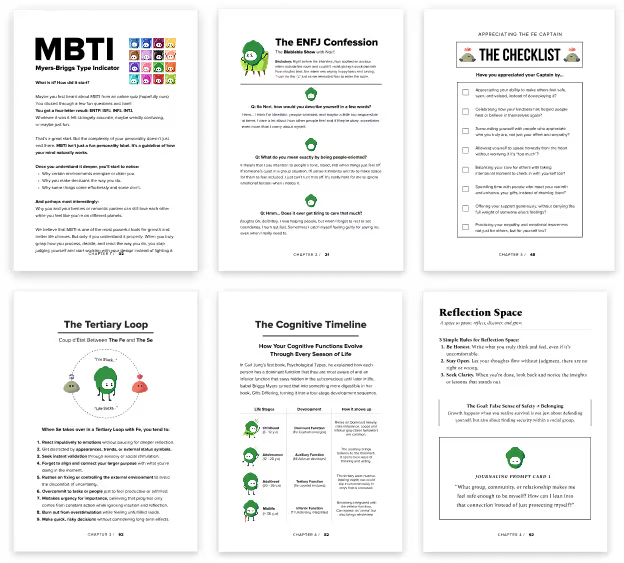
A Complete Self-Discovery Manual For An
ENFJ

A Visual Self-Discovery Guide for ENFJs Who Listen to everyone but rarely slow down to listen to themselves.

Instant access • Visually Structured • Made Specifically for ENFJ
Or See What’s Inside?
Thank You!
Your guide is on its way to your inbox.

Please check your email within the next 15 minutes. Don’t forget to check your spam or promotions folder just in case
Continue Exploring
Your Personalized [MBTI] Superpower Guide Is Ready!
We created a free illustrated guide to help you understand [MBTI]'s 5 best natural strengths. The guide will be sent to the email address you entered.
Thank You!
Your guide is on its way to your inbox.

Please check your email within the next 15 minutes. Don’t forget to check your spam or promotions folder just in case
Continue Exploring
Oops! Something went wrong while submitting the form.
------------------------------------------------------------------