NICO
THE COMMANDER
THE STRATEGIST

ENTJ

The ENTJ personality type is characterized by a natural drive to optimize systems for maximum efficiency and results. As one of the 16 Myers-Briggs personality types, ENTJs are driven by a powerful vision that guides their bold decisions and decisive action. They are especially skilled at organizing people and resources, clarifying direction, and driving goals forward with confidence and real results.

EXTRAVERTED
INTUITION
THINKING
JUDGING
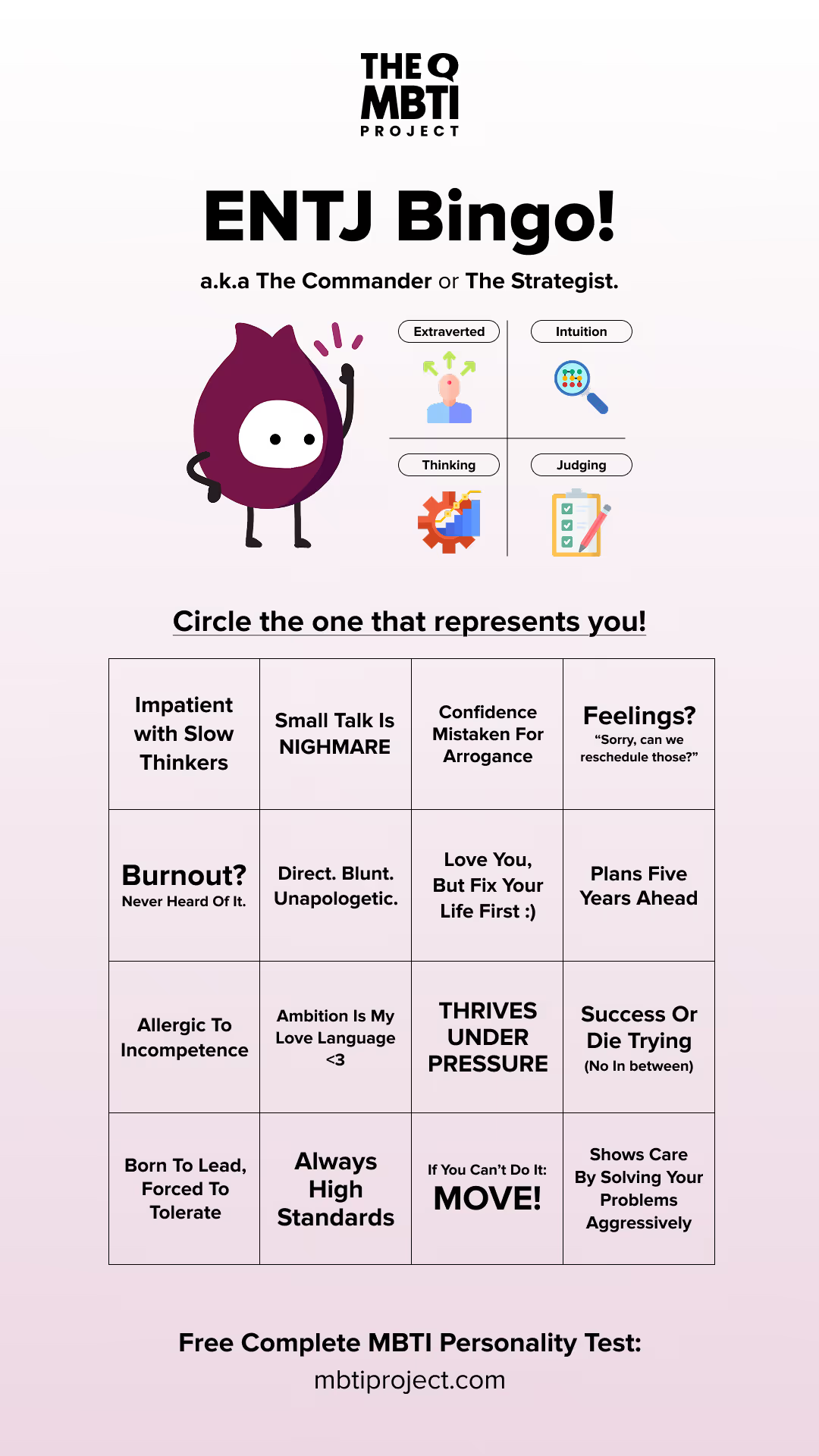
ENTJ BINGO!

Think you’re a real ENTJ?
Download this ENTJ Bingo, mark your squares, and post it on your Stories! Don’t forget to tag @thembtiproject. We’ll feature the best ones!

Download ENTJ Bingo

ENTJ Introduction

ENTJs are Extraverted (E), Intuitive (N), Thinking (T), and Judging (J) personalities who evaluate ideas, structures, and behaviors based on effectiveness and real results.They are driven to lead, execute, and redesign inefficient systems that are or no longer functional.

ENTJs earn the title The Commander because they instinctively take control and responsibility when clarity and direction are missing. Most of the time, it's not out of ego or pride, but it's simply because inefficiency feels unacceptable to them. They are also often called The Strategist because most of their decisions are guided by long-term purpose rather than short-term impulses.

ENTJs are vision builders that execute ideas into functional reality.
They are powerful catalysts for progress that lead others through clarity, competence, and shared purpose.

UNFORTUNATELY ACCURATE:

ENTJs don’t stop when they’re tired. They stop when they collapse. Their burnout isn’t caused by weakness, but by forgetting they’re human.

Classic ENTJ Lines:

"What's the goal here? If there isn't any, we're wasting time."

"C'mon! We can do better than this."

“I don’t care about busywork. What’s the progress?”

ENTJ Strengths

1. Strategic Future Vision & Foresight

ENTJs constantly track patterns, trajectories, and consequences to anticipate where things are heading. This gives them an unusual ability to define accurate direction over the long term.

2. Systematic Thinking

ENTJs instinctively see the structure behind everything: organizations, workflows, ideas, even social dynamics. They refine systems until they are efficient and functional.

3. Natural Decisive Leadership

Their ability to combine fast decision-making with long-term thinking makes them reliable in uncertain situations. While others hesitate, ENTJs assess quickly and act with clarity.

4. High Standards & Accountability

ENTJs carry a strong sense of ownership and take responsibility when things fail under their leadership. This mindset drives them to hold high standards for themselves and others.

5. Long-Term Resilience

ENFJs take responsibility and commitments seriously, especially when others depend on them. This is why they often become the backbone of a group or community.

6. Powereful Execution & Implementation

ENTJs can tolerate intense effort for extended periods when the goal truly matters to them. As long as they believe in the direction, they can sacrifice comfort and remain focused.

Your MBTI Superpower!

Download our free 15-page guide to the most underrated strengths of the ENTJs mind

ENTJ Weaknesses

1. Overidentifying with Results

ENTJs often tie their self-worth too closely to outcomes. When things fail, they can create intense self-pressure to push themselves harder than their body can sustain.

2. Impatience & Difficulty Slowing Down

ENTJs hate wasting time, even on themselves. Their intolerance for incompetence and inefficiency can drive them straight into burnout if they don’t deliberately slow down.

3. Overlooking Emotional Implications

ENTJs are not emotionless, but they often delay addressing them until they become problems. They may underestimate how their communication impacts others emotionally.

4. Tend to Overcontrol When Stressed

Under pressure, ENTJs can become excessively controlling. Instead of trusting the system, they may start micromanaging, believing everything must go through them to succeed.

ENTJ Relationships

ENTJ Communication Style

They naturally structure conversations around objectives, solutions, and outcomes rather than emotional processing or prolonged discussions that go nowhere. When they speak, they often use conversation as a tool to organize ideas and drive decisions forward. This can make them sound blunt or overly direct, but their intention is usually to remove ambiguity and accelerate progress.

Because ENTJs prioritize effectiveness, they tend to value honest feedback over social cushioning.
They respect competence and prefer conversations that are precise and actionable rather than vague or circular. However, this direct style can sometimes overlook emotional nuance. ENTJs may underestimate how strongly their words land, especially with more sensitive types, even though their underlying goal is usually to help improve outcomes, not to harm.

ENTJ Compatibility With Other Personalities

ENTJs tend to connect best with types who can match their logic and depth without requiring heavy emotional processing. They often form strong bonds with INTJ and INTP types, who respect competence and enjoy deep, concept-driven conversations without excessive emotional demand. An ENTP type can also be energizing partners for ENTJs, bringing intellectual stimulation, debate, and fresh creativity into the dynamic. ENTJs often appreciate INFJ type as well, as INFJs offer deep inner vision and emotional insight that can complement ENTJ drive and create balance.

ENTJs usually find the most challenge with types who prioritize emotional harmony over directness, or who resist structure and accountability. ESFP, ISFP, and ESFJ types may feel hurt or pressured by ENTJ bluntness, while ENTJs may feel frustrated by their lack of long-term direction. ISTP and ISTJ types can also clash with ENTJs when flexibility, pace, or control becomes an issue. However, with mutual respect, even the most contrasting types can become powerful complements.

ENTJ Main Need in Romantic Relationship

ENTJs want a relationship that feels like teamwork, not emotional dependency. They connect best with a partner who is independent, self-directed, and respectful of their ambition rather than threatened by it. Loyalty, honesty, and intellectual connection matter more than constant emotional reassurance. They seek relationships where conflict is handled maturely and both individuals actively support each other’s long-term goals.

ENTJ Main Fear in Romantic Relationship

ENTJs’ deepest relationship fear is losing sense over their own life direction. Not in a 'being controlled' way, but more in the sense of being trapped, limited, or emotionally drained by a relationship that weakens their vision. They fear becoming entangled in dynamics where they must constantly manage the partner's emotional instability or where their goals are always misunderstood or unsupported.

ENTJ Relationship Blindspots

Blind spots are unnoticed patterns or habits that can create misunderstandings or emotional distance, even when no harm is intended.

BLINDSPOT #1

Prioritizing Fixing Over Presence

ENTJs naturally respond to problems by optimizing or offering solutions. In romantic relationship, this can leave their partner feeling emotionally unheard, even when the ENTJ’s intention is to help.

BLINDSPOT #2

Underestimating Emotional Impact

ENTJs often underestimate how strongly their words, tone, and decisions affect others emotionally. They may miss subtle cues of hurt or disconnection until tension has already built up.

BLINDSPOT #3

Treating Relationship Like a Project

ENTJs are prone to tying their self-worth (and their partner’s) to performance and outcomes. While structure and goals can be helpful, their partner may feel evaluated rather than emotionally accepted.

ENTJ Careers

ENTJ Ideal Career Life

The ideal career path for an ENTJ involves roles where they can shape strategy, make decisions, and optimize systems rather than simply following instructions. They are energized by environments that that reward competence and accountability. More than job titles, ENTJs value having real influence to solving complex problems and building structures that actually function.

ENTJ Career Stressors

ENTJs experience the most career stress in environments where their competence is restricted rather than utilized. When they are expected to execute without having clarity over the long-term strategy or when decisions are controlled by people they perceive as less competent, ENTJs quickly become frustrated and disengaged.

ENTJs also experience high stress in chronically inefficient environments filled with repetitive meetings with no outcomes and disorganized workflows. Being forced to operate inside broken structures without the authority to fix them can lead to resentment and burnout. ENTJs don’t struggle with hard work, but they struggle with wasted effort.

Best Career Paths for ENTJ

Leadership & Executive Roles

Examples: CEO, Startup Founder, Business Owner, or General Manager.
ENTJs are built to carry responsibility. They function best when they are empowered to set direction and take ownership of the results. These roles suit ENTJs because they can effortlessly see where systems are failing and feel compelled to step into leadership to fix them.

Strategy & High-Level Problem Solving

Examples: Strategy Consultant, Business Strategist or Policy Advisor.
ENTJs shine in work environments where the primary task is thinking several steps ahead. Their ability to analyze complexity and recognize patterns is highly valued in these fields. ENTJs are motivated by challenges that demand structured thinking, not by routine mindless execution.

Systems & Operations Management

Examples: Operations Manager, Project Director, Supply Chain Manager.
ENTJs excel at transforming chaotic systems into structured ones. These roles allow them to design workflows, improve efficiency, and build scalable operations. ENTJs often become the person who naturally redesigns broken processes and creates order where dysfunction exists.

Law, Debate & Negotiation Fields

Examples: Corporate Lawyer, Legal Consultant, or Negotiator.
Law fields demand strong logic, assertiveness, and strategic communication, which are all natural strengths of ENTJs. They are comfortable in challenging flawed reasoning and navigating power dynamics. ENTJs enjoy environments where sharp thinking decides results.

Business & Financial Leadership

Examples: Investment Manager, Venture Capital Analyst, Biz Dev Lead.
ENTJs are highly compatible with environments where success is measurable and performance-based. They are motivated by clear metrics, targets, and tangible wins because these confirms effectiveness.

Technical Execution & Innovation

Examples: Engineering Manager, Product Manager, or Tech Founder.
In technical engineering fields, ENTJs often possess the qualities needed to rise into leadership roles. They are especially effective when they can bridge technical depth with strategic insight. ENTJ type could become a valuable force behind both product direction and organizational structure.

Careers to Avoid For ENTJ

Repetitive, Low-Complexity Work

Examples: Data Entry Clerk, Basic Bookkeeping, Assembly Line Worker.
ENTJs need intellectual challenge the way most people need emotional safety. Work that is predictable or mentally shallow drains them quickly because it offers no room for strategic problem-solving. Most ENTJs don’t burn out from workload, they burn out from boredom and underutilization.

Emotionally Intensive Caretaking Roles

Examples: Crisis Hotline Operator or Emotional Support Counselor.
ENTJs care about people, but they struggle in roles where the primary task is emotional containment rather than solution-building. Constant exposure to emotional distress without clear progression can overwhelm them and leave them feeling ineffective.

Careers With No Growth Opportunities

Examples: Dead-end Retail Roles or Static Government Clerk.
ENTJs need a trajectory. When a role offers no learning curve and no future path, they can start to feel disconnected (even if the job provides stability). Without progress, they may slowly disengage.

Politics Over Competence Environments

Examples: Offices Where Promotions Depend on Likability.
ENTJs lose respect for environments where image management or favoritism matters more than actual performance. In highly political cultures, ENTJs often feel trapped between playing games they dislike or staying honest and getting sidelined.

Real ENTJ Examples

Real Human ENTJ

Napoléon Bonaparte
(Former Emperor of The French)

“If you want a thing done well, do it yourself.”

“The strong man is the one who is able to intercept at will the communication between the senses and the mind."

Simon Cowell
(Entrepreneur & Producer)

“At 20, you're cocky and you think you can rule the world, and you get it all wrong."

"When someone asks, 'Does success make you into a monster?' I always say, 'No, it enables you to be a monster."

Garry Kasparov
(Chess Grandmaster)

“I learned that fighting on the chess board could also have an impact on the political climate in the country."

“I have some strategical vision, I could calculate some few moves ahead and I have an intellect that is badly missed in the country which is run by generals and colonels."

Katharine Hepburn
(American Actress)

"Without discipline, there's no life at all."

"My greatest strength is common sense. I'm really a standard brand - like Campbell's tomato soup or Baker's chocolate."

Fictional ENTJ Characters

Tywin Lannister
(Game of Thrones)

“A lion doesn't concern himself with the opinions of a sheep.”

“Explain to me why it is more noble to kill 10,000 men in battle than a dozen at dinner."

Muzan Kibutsuji
(Demon Slayer)

“The one thing I hate is “change”. Changes in circumstances. Changes in body. Changes in emotion. In most cases. Every change is “degradation."

"I haven’t got any punishments. I have been forgiven for killing hundreds of thousands of humans. I haven’t seen God or Buddha for a thousand years."

Erwin Smith
(Attack on Titan)

"It's us who gives meaning to our comrades' lives!"

“If you begin to regret, you'll dull your decisions and let others make your choices for you. All that's left for you then is to die. Nobody can foretell the outcome. Each decision you make holds meaning only by affecting the next decision.”

Five Hargreeves
(The Umbrella Academy)

"There's no such thing as good guys and bad guys, there's just people. You know what they call a superhero that works alone? Who doesn't listen to anybody? A villain."

"This is the price of being powerful. Sometimes, we step on ants"

Common ENTJ Mistypes

1. ENTP - Nimo

Why ENTJs mistype as ENTPs:

  • Both are outspoken, logic-driven, and comfortable to create a quick argument in a debate.
  • ENTPs can also appear ambitious when motivated, resembling ENTJ decisiveness.
  • Many tests mistakenly equate confidence and verbal assertiveness with dominant Extraverted Thinking (Te).

Key Differences:

  • ENTJ (Te Dominant): Prioritizes decisive closure and effective execution. Wants ideas to become structured systems.
  • ENTP (Ne Dominant): Prioritizes exploration, possibilities, and mental stimulation. Enjoys keeping options open-ended.
  • ENTJs naturally seek clear, measurable outcomes. ENTPs naturally seek novelty and intellectual exploration.
See ENTP's Profile
2. ESTJ - Nero

Why ENTJs mistype as ESTJs:

  • Both are Dominant Te users, which makes them assertive, highly structured, and strongly outcome-focused.
  • When stressed, ENTJs may become rigid and overly controlling, which can resemble ESTJs’ priority on maintaining structure, order, and tradition.

Key Differences:

  • ENTJ (Ni Auxiliary): Using future-oriented patterns and long-term vision to ground their judgments and decisions.
  • ESTJ (Si Auxiliary): Using past-oriented experiences and proven methods to ground their judgments and decisions.
  • ENTJs tend to innovate systems for improvement, while ESTJs tend to preserve systems for maintaining consistency & reliability.
See ESTJ's Profile
3. INTJ - Nova

Why ENFJs mistype as INFJs:

  • ENTJs’ private way of processing their feelings can be mistaken for introversion.
  • Both types are strategic, independent, and long-term thinkers.

Key Differences:

  • ENTJ (Te Dom & Ni Aux): Processes thinking externally by verbalizing ideas and organizing others.
  • INTJ (Ni Dom & Te Aux): Processes thinking internally and speaks only after forming full internal clarity.
  • ENTJs think by structuring the external world (people, goals, outcomes). INTJs think by structuring their internal world (concepts, frameworks, and mental models).
See INTJ's Profile
Cognitive Functions Test

Specifically Designed to Navigate Mistypes

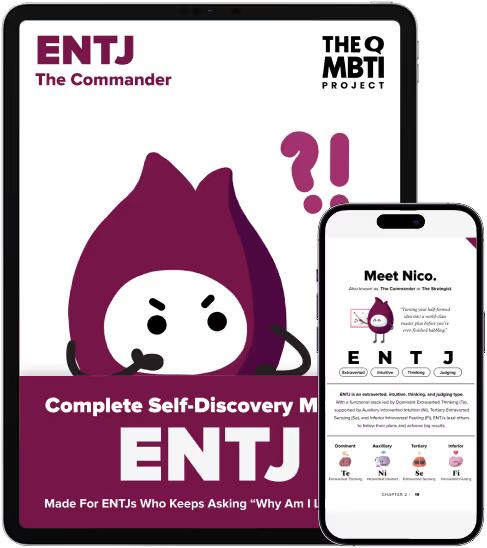
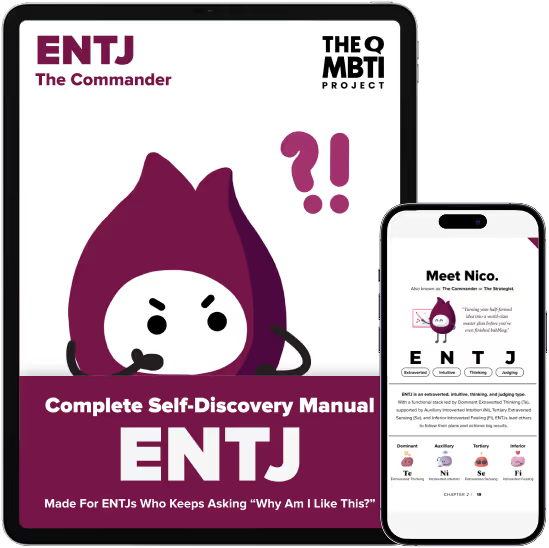
A Complete Self-Discovery Manual For An
ENTJ

A Visual Self-Discovery Guide for ENTJs Who Always Execute at a High Level But Want Clearer Internal Alignment.

Instant access • Visually Structured • Made Specifically for ENTJ
Or See What’s Inside?
Thank You!
Your guide is on its way to your inbox.

Please check your email within the next 15 minutes. Don’t forget to check your spam or promotions folder just in case
Continue Exploring
Your Personalized [MBTI] Superpower Guide Is Ready!
We created a free illustrated guide to help you understand [MBTI]'s 5 best natural strengths. The guide will be sent to the email address you entered.
Thank You!
Your guide is on its way to your inbox.

Please check your email within the next 15 minutes. Don’t forget to check your spam or promotions folder just in case
Continue Exploring
Oops! Something went wrong while submitting the form.
------------------------------------------------------------------