NERO
THE EXECUTIVE
THE ORGANIZER

ESTJ

The ESTJ personality type is characterized by a strong commitment to order, structure, and responsibility. As one of the 16 Myers-Briggs personality types, ESTJs are naturally driven to organize systems and environments in ways that ensure reliability and long-term stability. They often establish clear expectations and high standards to maintain consistency so that goals are achieved through disciplined and practical execution.

EXTRAVERTED
SENSING
THINKING
JUDGING

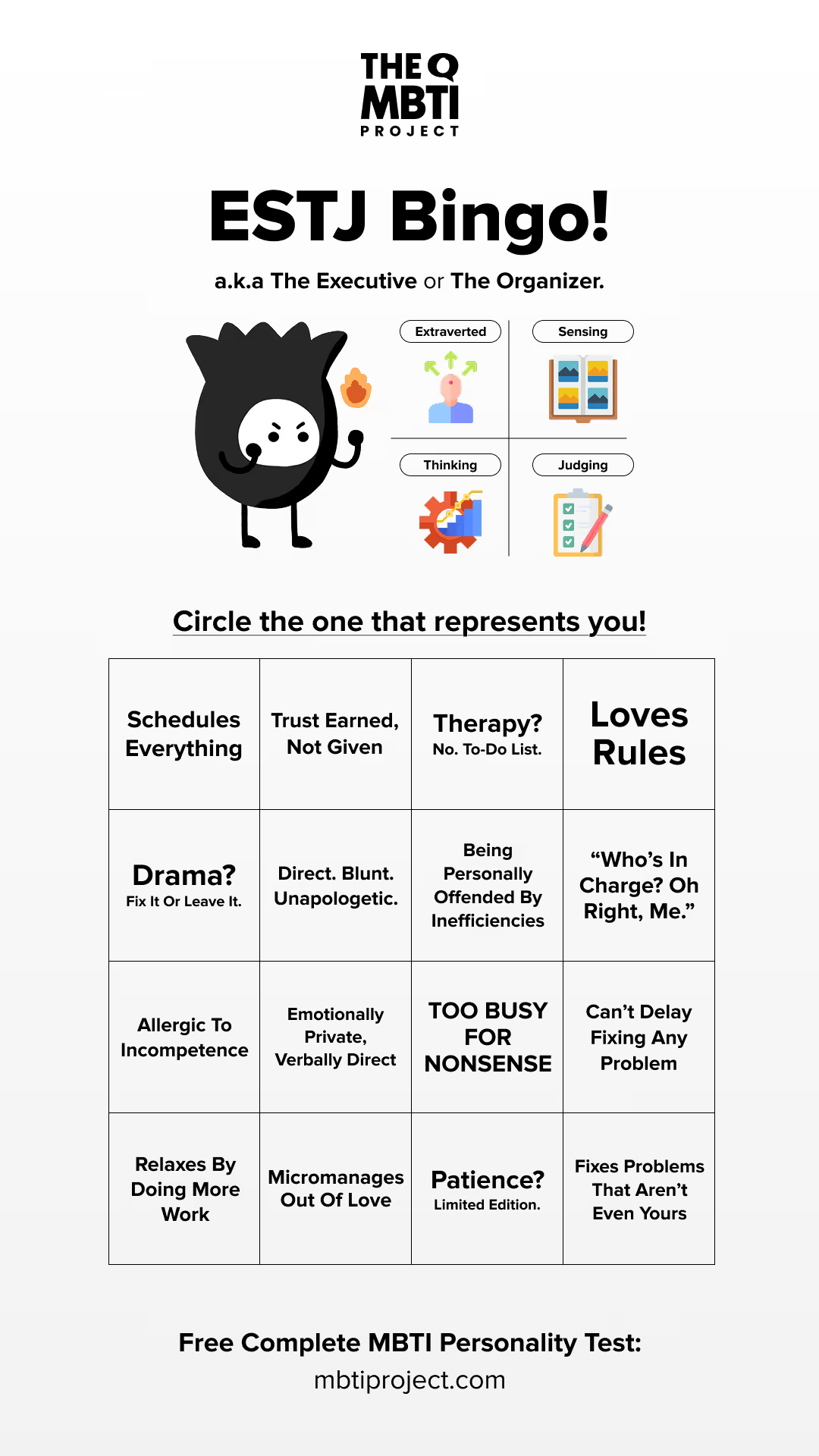
ESTJ BINGO!

Think you’re a real ESTJ?
Download this ESTJ Bingo, mark your squares, and post it on your Stories! Don’t forget to tag @thembtiproject. We’ll feature the best ones!

Download ESTJ Bingo

ESTJ Introduction

ESTJs are Extraverted (E), Sensing (S), Thinking (T), and Judging (J) personalities who are driven by a strong preference for structured systems and efficient outcomes. They prioritize objective logic and proven methods when making decisions, and function best when expectations, boundaries, and responsibilities are clearly defined.

ESTJs are often called The Organizer or The Executive because they instinctively step in when structure is missing. They quickly establish roles, standards, and workflows out of a genuine desire to create smooth and predictable functioning. In group settings, they are often the ones who initiate execution to turn plans into concrete results.

Although ESTJs are frequently perceived as overly strict, their deeper motivation is a strong sense of duty and a commitment to sustainable stability.
As they mature and learn to balance structure with flexibility, they often become leaders who are not only efficient but also highly dependable and trustworthy.

UNFORTUNATELY ACCURATE:

ESTJs don’t just dislike chaos. They take it personally. If no one steps up, they’ll take over and run the whole thing.

Classic ESTJ Lines:

"What’s the plan? Let’s define the roles first."

"Say what you mean, and do what you said."

"I'm not being rude. That's just the reality."

ESTJ Strengths

1. Effective System Builder & Organizer

ESTJs quickly recognize inefficiencies in structure. They organize systems and workflows to ensure people and processes function smoothly and reliably.

2. Strong Sense of Responsibility

ESTJs take ownership seriously, even when no one explicitly assigns it to them. Once they commit, they feel a strong internal obligation to perform at their best.

3. Highly Reliable & Dependable

ESTJs value punctuality, follow-through, and consistent performance regardless of mood. This steady discipline often earns them strong respect from others.

4. Objective Decision-Making

ESTJs ground their decisions in evidence and real outcomes rather than speculation. They are skilled at separating feelings from practical judgment, especially when clarity is required.

5. Naturally Result & Execution-Oriented

ESTJs are energized by measurable progress and tangible outcomes. They grow impatient with endless discussion when it does not lead to implementation or visible results.

6. Consistency in Standards & Quality

ENTJs can tolerate intense effort for extended periods when the goal truly matters to them. As long as they believe in the direction, they can sacrifice comfort and remain focused.

Your MBTI Superpower!

Download our free 15-page guide to the most underrated strengths of the ESTJs mind

ESTJ Weaknesses

1. Overly Rigid with Structure

ESTJs can become so attached to established systems that they resist change, even when the new approach is clearly better. Flexibility can feel like threat rather than opportunity.

2. Difficulty with Emotional Sensitivity

ESTJs may unintentionally dismiss emotional complexity due to their strong reliance on logic. They might solve problems while missing the emotional validation others need.

3. Over-Control When Under Stress

In the face of disorder or inefficiency, ESTJs can double down on control. This can show up as micromanaging, enforcing harsh rules, or becoming overly critical.

4. Self-Worth Tied to Productivity

Many ESTJs unconsciously measure their self-value by performance and achievement. When they are not being productive, they may experience guilt or strong internal pressure.

ESTJ Relationships

ESTJ Communication Style

ESTJs typically communicate in a direct and structured manner. Their primary intention is to clarify points, state facts, and guide conversations toward decisions and outcomes. They often sound confident and decisive, especially in professional settings. They dislike vague communication and may become frustrated when discussions remain abstract without practical direction.

ESTJs may not naturally lead with emotional expression, but that does not mean they lack care.
Their default communication style is problem-solving rather than emotional processing. When someone shares a problem, their instinct is to offer solutions rather than validation. This can sometimes make them appear blunt or insensitive, even when their intention is genuinely to help.

ESTJ Compatibility With Other Personalities

ESTJs tend to feel most compatible with types who either share their need for structure or complement their strengths. Fellow SJ types such as ISTJ and ESFJ often connect easily with ESTJs because they also value reliability, responsibility, and clear expectations, which makes communication practical and grounded. ISFJ can also be a strong match, as they appreciate the stability ESTJs provide while offering emotional warmth in return. Beyond SJ types, ESTJs may pair well with healthy INTJ and ENTJ, where shared respect for logic, competence, and goal orientation creates mutual admiration.

ESTJs often experience the most friction with types that function with abstract exploration, emotional fluidity, or strong resistance to structure. Types like INFP and ENFP may feel constrained by ESTJ’s directness and preference for rules, while ESTJs may feel frustrated by their flexible nature. INTP can be challenging because they prefer open-ended exploration, which can feel inefficient to an ESTJ who wants closure and execution. Similarly, highly spontaneous types like ESFP may clash with ESTJs around discipline and long-term planning. However, these challenges are not signs of incompatibility. With maturity and mutual understanding, these opposite dynamics can actually become powerful sources of growth.

ESTJ Main Need in Romantic Relationship

ESTJs seek stability above all in relationships. They feel most secure when commitments are clear and actions consistently match words. Their trust isn’t built on words alone, but on everyday reliability: Presence, follow-through, and the shared effort of building something together. When that stability is established, they become fiercely loyal and deeply invested partners.

ESTJ Main Fear in Romantic Relationship

What ESTJs fear most in relationships is uncertainty. They struggle with partners who feel unreliable or unclear about where things are going. Behind their desire for clear expectations is usually a strong need to know that the relationship has long-term security. When that security feels shaky, they may become more controlling to protect what makes them feel safe again.

ESTJ Relationship Blindspots

Blind spots are unnoticed patterns or habits that can create misunderstandings or emotional distance, even when no harm is intended.

BLINDSPOT #1

Struggling With Emotional Processing

ESTJs may struggle with slower emotional processing in others, while also minimizing their own emotions. Over time, these unexpressed feelings can surface as frustration, leaving partners confused about the real issue.

BLINDSPOT #2

Assuming Effort Speaks for Itself

ESTJs often believe that providing stability and taking responsibility should naturally be enough. They may overlook the importance of emotional expression and vulnerability in building a fulfilling relationship.

BLINDSPOT #3

Overcontrol When Feeling Threatened

When they sense instability in the relationship, ESTJs may try to regain control by becoming more critical or directive. This can unintentionally create pressure rather than the safety they’re trying to protect.

ESTJ Careers

ESTJ Ideal Career Life

An ideal career life for an ESTJ is built around environments where expectations are clearly defined and success is measured through real outcomes rather than subjective impressions. They feel most engaged when given the authority to structure systems and make practical decisions that lead to visible results. ESTJs prefer workplaces that reward competence over politics. When their role allows them to see consistent progress toward tangible goals, they experience high satisfaction and sustained motivation.

ESTJ Career Stressors

ESTJs struggle most in workplaces with weak structure. Vague roles and constantly shifting goals quickly frustrate them. Their natural way of functioning depends on accountability and reliability. Without these elements, they may feel their effort is being wasted within a broken system.

They are also strongly stressed by inefficiency that goes unaddressed. ESTJs  are natural hard workers that hold themselves to high standards, , so environments that tolerate poor performance, chronic lateness, or lack of ownership often feel deeply unfair. When effort and discipline are not rewarded (or worse, avoided), they may begin to feel resentful, especially if they find themselves carrying the workload for others.

Best Career Paths for ESTJ

Operations, Management & Leadership Roles

Examples: Operations Manager, Project Manager, and Team Lead.
ESTJs perform best when they are responsible for coordinating people and ensuring outcomes while maintaining clear standards. These roles allow them to apply their natural strengths in organization and accountability.

Business, Administration & Systems

Examples: Business Administrator, Secretary, or Compliance Officer
Administrative and organizational roles appeal to ESTJs because they are structured around reliable processes and systems. These environments naturally reward their precision and attention to detail. The consistency and predictability of this work often feels deeply satisfying to them.

Law, Regulation & Institutional Enforcement

Examples: Lawyer (Corporate or Regulatory Law), Judge, Police Officer.
ESTJs often feel a strong internal sense of duty to uphold fairness and enforce boundaries. These roles allow them to apply objective logic in meaningful ways, especially when they believe the system serves a legitimate purpose.

Finance & Performance-Based Fields

Examples: Accountant, Auditor, Financial Analyst, Investment Manager.
Finance-related careers naturally attract ESTJs because they emphasize clear metrics and objective evaluation. ESTJs are most engaged in environments where performance is trackable. They value roles that involve strategic planning and responsibility over financial resources.

Technical & Industrial Fields

Examples: Industrial Engineer, Supply Chain Manager, Quality Control.
Logistics, production, infrastructure, and system coordination appeal to ESTJs because these fields involve systems that can be refined to operate efficiently and reliably. They often take pride in seeing projects completed and operations functioning smoothly as a result of their management.

Public Service & Structured Service Roles

Examples: Military Officer, Government Official, or Public Administrator.
Highly structured service roles align closely with ESTJs’ core values of duty, discipline, hierarchy, and long-term commitment. They often feel most fulfilled when contributing to something larger than themselves, especially when the system functions well and the responsibility is concrete.

Careers to Avoid For ESTJ

Highly Unstructured & Ambiguous Work

Examples: Fine Artist or Experimental Filmaker / Musician
ESTJs generally need external structure. Deadlines, standards, systems, and accountability. In environments driven purely by inspiration or self-expression, they may feel disoriented, underutilized, or mentally unsafe.

Emotionally Heavy Support Roles

Examples: Trauma Therapist, Crisis Counselor, or Hospice Caregiver.
Roles that require continuous emotional containment and prolonged exposure to distress can be deeply draining for ESTJs. Their natural instinct is to solve problems, not to sit in unresolved emotional processing.

Theory-Heavy Fields With Little Output

Examples: Pure Philosophy Academic or Abstract Literary Critic
ESTJs are energized by tangible impact. Careers centered on conceptual exploration or open-ended theorizing can feel empty when there is no immediate feedback from real-world application.

Politics Over Competence Environments

Examples: Office Environments Dominated by Favoritism
Workplaces where success depends more on image-building, favoritism, or social maneuvering than on competence tend to deeply frustrate ESTJs. They value fairness, transparency, and merit. When effort matter less than politics, they often become cynical and disengaged.

Real ESTJ Examples

Real Human ESTJ

Gordon Ramsay
(British Chef)

"The minute you start compromising for the sake of massaging somebody's ego, that's it, game over."

"Cooking is about passion, so it may look slightly temperamental in a way that it's too assertive to the naked eye."

Piers Morgan
(Broadcaster & Journalist)

"If we do not believe in freedom of speech for people we despise, we do not believe in it at all."

"There is a type of snobbish, pompous journalist who thinks that the only news that has any validity is war, famine, pestilence or politics. I don’t come from that school."

Candace Owens
(Political Commentator)

"You can still say whatever you want to say on social media, but you have to be willing to stand by your words."

"We cannot rely on a hopelessly inefficient and burdensome government to fix what we ourselves refuse to do."

Hillary Clinton
(American Politician)

"Every moment wasted looking back, keeps us from moving forward."

“In the bible it says you have to forgive seventy times seven. I want you all to know, I'm keeping a chart.”

Fictional ESTJ Characters

Hermione Granger
(Harry Potter)

"I mean, you could claim that anything’s real if the only basis for believing in it is that nobody’s proved it doesn’t exist!"

"Actually I’m highly logical which allows me to look past extraneous detail and perceive clearly that which others overlook."

Tenya Iida
(My Hero Academia)

"Wanting to do it and being suitable for it are different issues"

"“I won’t let go! I’ll come running no matter where to take the hand of a lost child! I’m Ingenium! Meddling when you don’t need to... is the essence of being a hero, right?”"

Jean Kirstein
(Attack on Titan)

"I'm an honest man. It’s better than acting all tough when you’re scared shitless."

"I don't really want to meet a disappointing end with someone burning my bones without knowing who they belonged to."

Monica Geller
(Friends)

"I need you to be careful and efficient, and remember, if I'm harsh with you, it's only because you're doing it wrong."

"Welcome to the real world! It sucks. You're gonna love it."

Common ESTJ Mistypes

1. ENTJ - Nico

Why ESTJs mistype as ENTJs:

  • Both lead with Extraverted Thinking (Te), which naturally makes them both confident, decisive, and inclined toward leadership.
  • Both often hold managerial roles and value tangible results.

Key Differences:

  • ESTJ (Si Auxiliary): Tend to rely more on proven methods, tradition, and past experience.
  • ENTJ (Ni Auxiliary): Tend to focus more on future vision, pattern recognition, and long-term strategy.
  • ESTJs are more likely to ask, “What has worked before?”, while ENTJs are more likely to ask, “What could work better?”
See ENTJ's Profile
2. ISTJ - Nilo

Why ESTJs mistype as ISTJs:

  • Both share the same function stack (Te–Si for ESTJ & Si–Te for ISTJ), just in different order.
  • Both share a strong sense of responsibility and a preference for structure.

Key Differences:

  • ESTJ (Te Dom & Si Aux): Leads with organizing the external world first, then validates it with past experience.
  • ISTJ (Si Dom & Te Aux): Leads with internal reference and certainty first, then organizes the external world.
  • When asked to organize a messy project, ESTJs are more likely to step in and directly structure the team, while ISTJs are more likely to first review the situation internally to gain clarity.
See ISTJ's Profile
3. ESFJ - Nyra

Why ESTJs mistype as ESFJs:

  • Both value structure, routines, and clear expectations.
  • Both often ENTJs’ private way of processing their feelings
  • They both often show care through practical actions (helping, organizing, taking responsibility).

Key Differences:

  • ESTJ (Te Dominant): Prioritizes objective standards, fairness, and effectiveness.
  • ESFJ (Fe Dominant): Prioritizes social harmony, emotional attunement, and group dynamics.
  • When making group decisions, ESTJs typically prioritize fairness and effectiveness, whereas ESFJs are more attentive to the emotional impact on everyone involved.
See ESFJ's Profile
Cognitive Functions Test

Specifically Designed to Navigate Mistypes

A Complete Self-Discovery Manual For An
ESTJ

A Visual Self-Discovery Guide for ESTJs Who Take Charge of Everything, Yet Find It Hard to Maintain Internal Balance.

Instant access • Visually Structured • Made Specifically for ESTJ
Or See What’s Inside?
Thank You!
Your guide is on its way to your inbox.

Please check your email within the next 15 minutes. Don’t forget to check your spam or promotions folder just in case
Continue Exploring
Your Personalized [MBTI] Superpower Guide Is Ready!
We created a free illustrated guide to help you understand [MBTI]'s 5 best natural strengths. The guide will be sent to the email address you entered.
Thank You!
Your guide is on its way to your inbox.

Please check your email within the next 15 minutes. Don’t forget to check your spam or promotions folder just in case
Continue Exploring
Oops! Something went wrong while submitting the form.
------------------------------------------------------------------