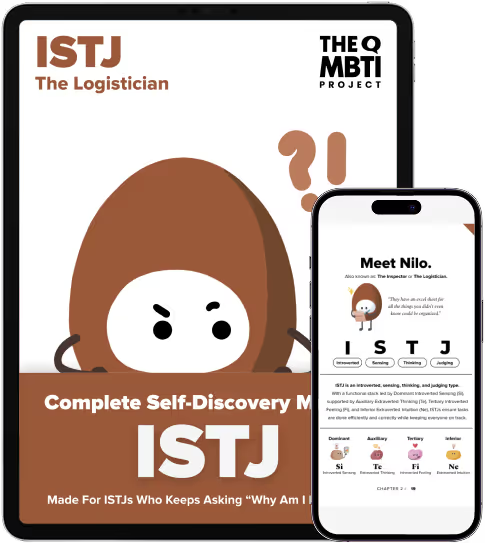
nILO
THE INSPECTOR
THE LOGISTICIAN

ISTJ

The ISTJ personality type is characterized by reliability, practicality, and a strong sense of duty. As one of the 16 Myers-Briggs personality types, ISTJs are dependable individuals who often become the structural foundation of the systems they are part of. They are driven to preserve stability, uphold standards, and ensure consistency in everything they manage.

INTROVERTED
SENSING
THINKING
JUDGING

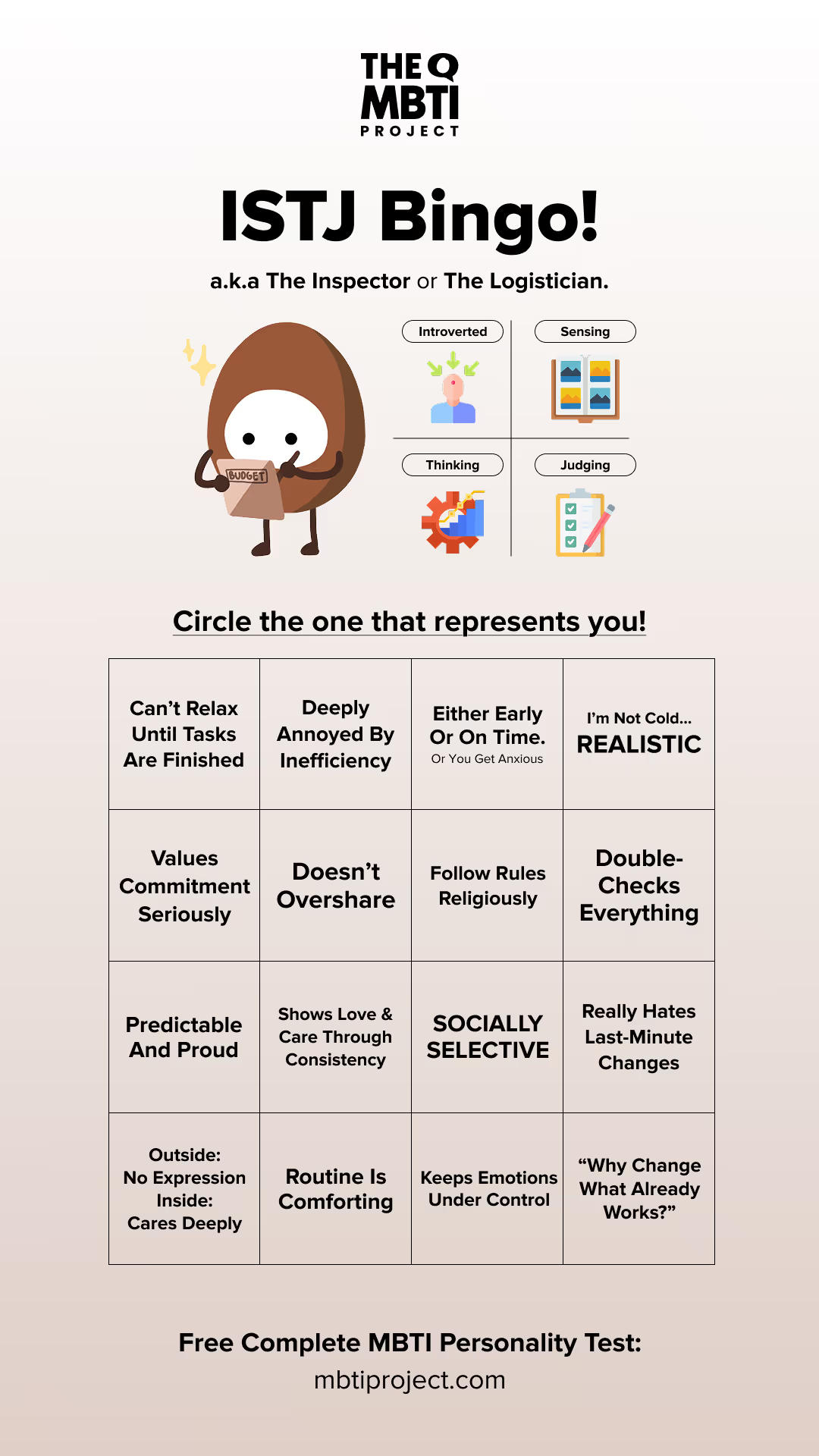
ISTJ BINGO!

Think you’re a real ISTJ?
Download this ISTJ Bingo, mark your squares, and post it on your Stories! Don’t forget to tag @thembtiproject. We’ll feature the best ones!

Download ISTJ Bingo

ISTJ Introduction

ISTJs are Introverted (I), Sensing (S), Thinking (T), and Judging (J) personalities who experience the world through observation, internal reflection, and strong personal standards. They rely heavily on past experience to guide their decisions and generally trust what has been proven to work over what is merely hypothetical.

ISTJs are often called The Inspector because they naturally notice details that most people miss and feel responsible for preserving stability and quality within their environment. They instinctively assess whether systems are functioning properly and whether standards are being respected. The term The Logistician reflects their strength in organizing systems and resources to ensure that things run smoothly and reliably.

While they may appear reserved, ISTJs often serve as the foundation that keeps families and organizations functioning.
They may not be loud in the way they lead, but they always carry their responsibilities with consistency, resilience, and strong commitment.

UNFORTUNATELY ACCURATE:

It is easier for ISTJs to trust calendars, checklists, and SOPs than human beings. But once they trust a person, that loyalty usually runs deep.

Classic ISTJ Lines:

"We’ve done this before, let’s just stick to the plan."

[Noticing the lack of organization] "It's fine. I’ll handle it."

“Come on, guys. I already put it in the calendar.”

ISTJ Strengths

1. Consistency & Reliability

ISTJs are reliable because they naturally anchor their behavior to routine and structure. Once they commit on something, they build their life around honoring that commitment.

2. Strong Sense of Responsibility

While most people carry responsibilities out of external pressure, ISTJs follow through out of internal obligation. They carry a private moral code about what is “proper,” “fair,” and “right,”.

3. Precision & Detail Awareness

ISTJs naturally store detailed memory of how things should look or function. This makes them excellent at noticing subtle issues, errors, and inconsistencies.

4. Realistic & Practical Judgment

ISTJs prefer decisions grounded in what is tested and verifiable. They are often the ones who prevent impulsive choices that only look good or exciting on the surface.

5. System Building & Process Thinking

ISTJs naturally think in terms of workflows, procedures, roles, timeline. They don't just fix bottlenecks in systems, they design ones where problems are less likely to occur.

6. Enduring Deep Loyalty

ISTJs’ trust is built slowly through consistent behavior, but once established, it runs deep. They rarely let go of relationships, commitments, or partnerships they value.

Your MBTI Superpower!

Download our free 15-page guide to the most underrated strengths of the ISTJs mind

ISTJ Weaknesses

1. Resistance to Change

ISTJs feel safest when they can rely on what has already worked. This can make them hesitant to try new approaches, causing them to miss opportunities in environments that change quickly.

2. Difficulty Tolerating Inefficiency

Extended exposure to poor systems can trigger tension and frustration in ISTJs. In response, they may become overly controlling to ensure things meet their internal standards.

3. Harsh Standards Toward Self and Others

ISTJs tend to hold themselves to strict internal standards and may believe others should do the same. This can lead to disappointment when people have different capacities or priorities.

4. Struggle to Delegate & Let Go of Control

ISTJs may struggle to trust others to execute tasks properly. Their concern is less about intention and more about whether outcomes will meet the standards they expect.

ISTJ Relationships

ISTJ Communication Style

ISTJs communicate in a direct and concise way. They prefer tend to focus on facts, details, and what is realistically actionable. ISTJs typically think privately before speaking and tend to speak only when they believe their input is necessary or useful. This can make their tone seem cold to more emotionally expressive individuals, even when no harm is intended.

ISTJs value honesty and consistency in communication and often become frustrated by vague language or emotionally ambiguous messages.
They usually mean exactly what they say and expect others to do the same. However, they are not unempathetic communicators. They simply express care by listening attentively, remembering details, respecting perspectives, and communicating honestly.

ISTJ Compatibility With Other Personalities

ISTJs feel most connected to people whose behavior is consistent and whose words align with their actions. They often experience the strongest natural compatibility with types who also value responsibility and dependability, such as ISFJ, ESTJ, and ESFJ. These types tend to share similar priorities around consistency, structure, and commitment. ISTJs can also form balanced, complementary connections with certain intuitive types like INFJ or INTJ, where the dynamic often centers on mutual respect for depth and the desire to build something long-lasting.

ISTJs often experience more friction with types who prefer spontaneity and emotional expressiveness, such as ENFP, ESFP, ENTP, or ESTP. These personalities’ exploratory nature can clash with ISTJs’ preference for predictability. Highly emotion-driven types such as INFP or ISFP can also present challenges if communication becomes overly emotional. However, when both sides develop self-awareness and mutual respect, these contrasting dynamics can become deeply complementary rather than divisive.

ISTJ Main Need in Romantic Relationship

The core need of an ISTJ in a relationship is trust built through consistency. They feel most secure with partners who are reliable and honor their commitments. ISTJs value emotionally stable and consistent partners more than emotional intensity or grand romantic gestures. Being appreciated also matters deeply to them. When their effort is taken for granted, it can slowly hurt their willingness to keep giving.

ISTJ Main Fear in Romantic Relationship

An ISTJ’s deepest fear in a relationship is investing deeply in someone who turns out to be unreliable. They fear committing their time, effort, and trust to a partner who doesn’t consistently show up or keep their word. Since their sense of emotional security is rooted in trust and consistency, realizing that a partner cannot be depended on can feel like the collapse of the very foundation they were trying to build.

ISTJ Relationship Blindspots

Blind spots are unnoticed patterns or habits that can create misunderstandings or emotional distance, even when no harm is intended.

BLINDSPOT #1

Showing Love Only in Familiar Patterns

ISTJs often believe that showing up and taking care of practical things is enough. The issue is rarely a lack of love, but a misalignment between their expression of love and their partner’s emotional needs.

BLINDSPOT #2

Prioritizing Logic Processing Emotion

ISTJs may treat relationships as projects: Fix the issues, meet the standards, stay consistent. But love isn’t just about maintenance. They may overlook how deeply emotional presence and romance matter to their partner.

BLINDSPOT #3

Slow to Adjust as Relationship Evolves

ISTJs are excellent at maintaining relationships, but may struggle when a relationship needs to transition into a new phase. They may cling to what used to work instead of adjusting to what’s needed now.

ISTJ Careers

ISTJ Ideal Career Life

ISTJs function best in structured environments with clear roles, expectations, and boundaries. They require work that allows them to apply practical reasoning and protect the quality of outcomes.ISTJs feel most fulfilled when their contributions result in systems that function reliably because of their effort. Recognition of their integrity, consistency, and discipline is also essential to their long-term engagement.

ISTJ Career Stressors

ISTJs experience significant stress in work environments that lack clarity and structure. Vague expectations and poorly defined roles force them to operate without stability, quickly draining their mental energy.

Unreliable teammates can also create deep frustration for ISTJs, as they often feel pressured to compensate for others’ shortcomings.
As the gap between their internal standards and external reality widens, they may start taking on responsibilities that aren’t theirs, which can gradually lead to resentment and burnout.

Best Career Paths for ISTJ

Operations & Process Management

Examples: Operations Manager, Supply Chain Planner, Office Manager.
ISTJs perform in environments where the primary goal is maintaining stability and continuity. They perform best when clear procedures and structures guide their work. These environments reward discipline, attention to detail, and accountability (as these are their main strengths).

Finance, Accounting & Data Accuracy Fields

Examples: Accountant, Auditor, Tax Consultant, or Financial Analyst.
ISTJs are naturally suited to work that demands precision and trustworthiness. They feel most comfortable when dealing with concrete data.These careers allow them to maintain standards and feel confident that their work produces measurable and predictable outcomes.

Law, Policy & Regulatory Fields

Examples: Lawyer, Legal Counsel, Paralegal, Judge, or Notary.
ISTJs tend to respect formal systems where structure, procedure, and fairness are central. They work well when expectations are clearly defined and grounded in established frameworks. These fields appeal to their natural sense of responsibility and rightfulness.

Engineering & Technical Systems

Examples: Civil Engineer, Systems Analyst, or Mechanical Engineer.
ISTJs perform better in fields where problems have clear logical structure. Engineering fields allow them to demonstrate competence through systematic and methodical thinking. These fields also reward patience in building reliable systems, instead of constant pursuit of quick fixes.

Project Management (Structured Workplace)

Examples: Project Manager (Construction, Engineering, IT, Operations).
ISTJs function best in environments with clear objectives and structured timelines. Work centered on project execution and management allows them to maintain order and consistency without the need to perform socially for attention.

Quality Control & Standards-Based Work

Examples: QA Specialist, QC Inspector, ISO Auditor, or Risk Manager.
ISTJs naturally notice deviations and inconsistencies within systems. Their strong sense of responsibility and attention to detail supports roles focused on quality assurance, failure prevention, and risk management.

Careers to Avoid For ISTJ

Unstructured Workplace With Constant Shift

Examples: Early-Stage Startup Where “Everyone Does Everything”
ISTJs experience high stress in environments where priorities or roles shift daily Their minds naturally seek stability. so when nothing feels predictable, they are forced to stay in a constant state of mental alertness. This doesn’t make them feel productive and quickly drains their energy.

Emotionally Intense Helping Professions

Examples: Crisis Counselor, Trauma Therapist, or Family Therapist.
ISTJs can be deeply caring, but they are not energized by continuous emotional processing. Careers that require them to constantly hold emotional space without clear resolution often lead to frustration, as they cannot measure progress in the way they are used to.

Persuasion-Based or Image-Driven Work

Examples: Comission-Only Sales or Trend-Driven Content Creator.
In environments where success depends heavily on charm or social influence, they often feel internally conflicted. They may feel pressured to perform socially in ways that feel inauthentic. Over time, this erodes their confidence in the system and in themselves.

Multitasking, Constant Interruption Roles

Examples: Event Coordinator, Live Chat Support, Front Desk.
ISTJs work best with sustained focus. Frequent interruptions and task-switching prevent them from entering their natural state of deep concentration. These environments can leave them feeling scattered and unable to perform at the standard they expect of themselves.

Real ISTJ Examples

Real Human ISTJ

George Washington
(First USA President)

"If the freedom of speech is taken away, then dumb and silent we may be led, like sheep to the slaughter."

"Discipline is the soul of an army. It makes small numbers formidable; procures success to the weak, and esteem to all."

Queen Elizabeth II
(Former Queen of UK)

"Over the years, those who have seemed to me to be the most happy, contented and fulfilled have always been the people who have lived the most outgoing and unselfish lives."

"But let us not take ourselves too seriously. None of us has a monopoly of wisdom, and we must always be ready to listen and respect other points of view."

Tim Cook
(CEO of Apple)

“Life is fragile. We're not guaranteed a tomorrow so give it everything you've got."

"You can focus on things that are barriers or you can focus on scaling the wall or redefining the problem."

Natalie Portman
(Actress & Film Producer)

"I don't love studying. I hate studying. I like learning. Learning is beautiful."

"I always ask myself, would I want someone to do something that wasn't comfortable for them just to please me? And the answer is no."

Fictional ISTJ Characters

Robin
(Teen Titans)

"When there's trouble, you know who to call."

“There is Good, and there is Evil, but the line between them can be almost impossible to find. Does one good deed make him a hero? Am I to blame for all of it because of a single mistake?"

Giyū Tomioka
(Demon Slayer)

"The weak have no rights or choices. Their only fate is to be relentlessly crushed by the strong."

" Feel the rage. The powerful, pure rage of not being able to forgive will become your unswerving drive to take action!"

Neji Hyūga
(Naruto)

"Fear. That is what we live with. And we live it every day. Only in death are we free of it."

“These eyes of mine show me many things. One thing they’ve shown me…People’s limitations are set, fixed, and unchangeable. Only a fool wastes his time trying to become something he can never be."

Mikasa Ackerman
(Attack on Titan)

"Once I’m dead, I won’t even be able to remember you. So I’ll win, no matter what. I’ll live, no matter what!"

"There are only so many lives I can value. And… I decided who those people were six years ago."

Common ISTJ Mistypes

1. INTJ - Nova

Why ISTJs mistype as INTJs:

  • Both value logic, efficiency, and structured planning.
  • Many ISTJs who are strategic or academically strong get labeled “INTJ.”
  • Online tests often confuse the Dominant Si of ISTJ with the Dominant Ni of INTJ because both seem reflective on surface.

Key Differences:

  • ISTJ (Si Dominant): Rely more on what has been proven, past experience, and tested methods.
  • INTJ (Ni Dominant): Rely more on internal vision, future patterns, and anticipated insights.
  • ISTJs trust what has been proven by past evidence, while INTJs trust what they envision will work in the future.
See INTJ's Profile
2. ISFJ - Noki

Why ISTJs mistype as ISFJs:

  • Both are Si-Dominant (highly responsible, reliable, and routine-oriented).
  • Both value stability, tradition, and consistency.
  • Many emotionally caring ISTJs are often assumed to be Feeling types.

Key Differences:

  • ISTJ (Te Auxiliary): Prioritize objective logic and efficiency in decision-making.
  • ISFJ (Fe Auxiliary): Prioritizes emotional harmony and interpersonal comfort in decision-making.
  • In group settings, ISTJs tend to prioritize what will make the system function most effectively, while ISFJs tend to prioritize what will help everyone feel included, understood, and emotionally supported.
See ISFJ's Profile
3. ESTJ - Nero

Why ISTJs mistype as ESTJs:

  • Both use the same cognitive functions (Si–Te–Fi–Ne), just in slightly different order.
  • Work-focused ISTJs with leadership roles are frequently mistyped as ESTJ.
  • ISTJs who develop greater assertiveness in communication may begin to display behaviors that resemble Te dominance.

Key Differences:

  • ISTJ (Si Dom & Te Aux): Builds decisions from internal past experience and evaluation first, then uses logic to organize the external world.
  • ESTJ (Te Dom & Si Aux): Acts on external efficiency and structure first, then uses personal experience to support and reinforce their decisions.
  • ISTJs stabilize themselves internally before acting outwardly, while ESTJs act outwardly to impose structure before reflecting internally.
See ESTJ's Profile
Cognitive Functions Test

Specifically Designed to Navigate Mistypes

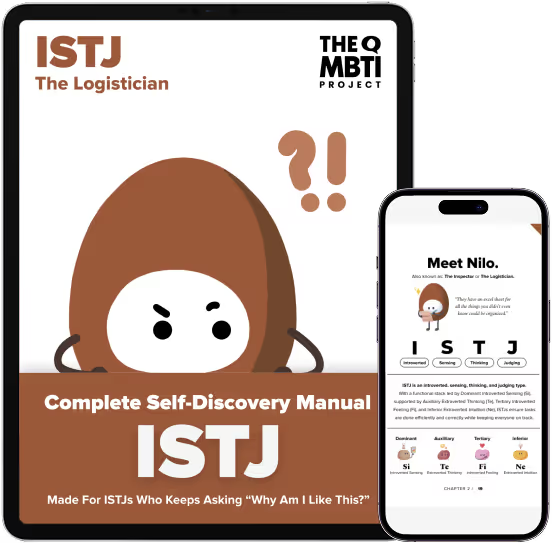
A Complete Self-Discovery Manual For An
ISTJ

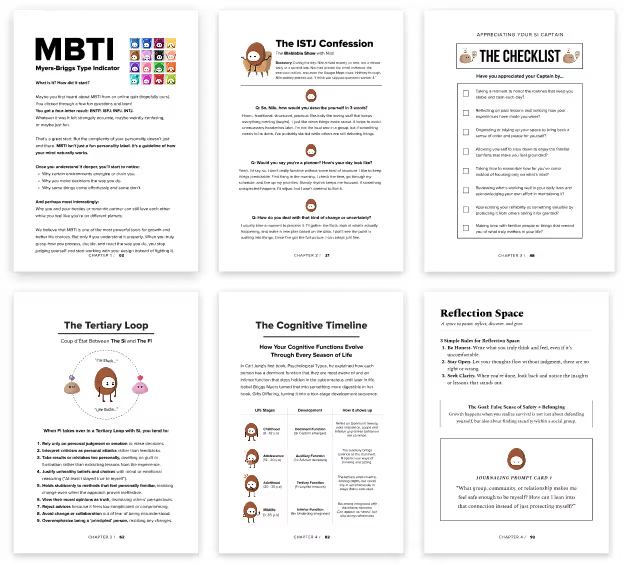
A Visual Self-Discovery Guide for ISTJs Who Want to Stop Carrying Responsibilities While Sacrificing Their Own Well-Being.

Instant access • Visually Structured • Made Specifically for ISTJ
Or See What’s Inside?
Thank You!
Your guide is on its way to your inbox.

Please check your email within the next 15 minutes. Don’t forget to check your spam or promotions folder just in case
Continue Exploring
Your Personalized [MBTI] Superpower Guide Is Ready!
We created a free illustrated guide to help you understand [MBTI]'s 5 best natural strengths. The guide will be sent to the email address you entered.
Thank You!
Your guide is on its way to your inbox.

Please check your email within the next 15 minutes. Don’t forget to check your spam or promotions folder just in case
Continue Exploring
Oops! Something went wrong while submitting the form.
------------------------------------------------------------------