NOMI
THE ADVOCATE
THE MYSTIC

INFJ

The INFJ personality type is characterized by a deep sense of purpose that is continuously refined over time. As one of the 16 Myers-Briggs personality types, INFJs are naturally drawn to understanding underlying patterns and exploring deeper meaning in everything around them. Rather than focusing only on what is visible, INFJs instinctively seek the hidden insights and truths beneath people’s behavior and life’s circumstances.

INTROVERTED
INTUITION
FEELING
JUDGING
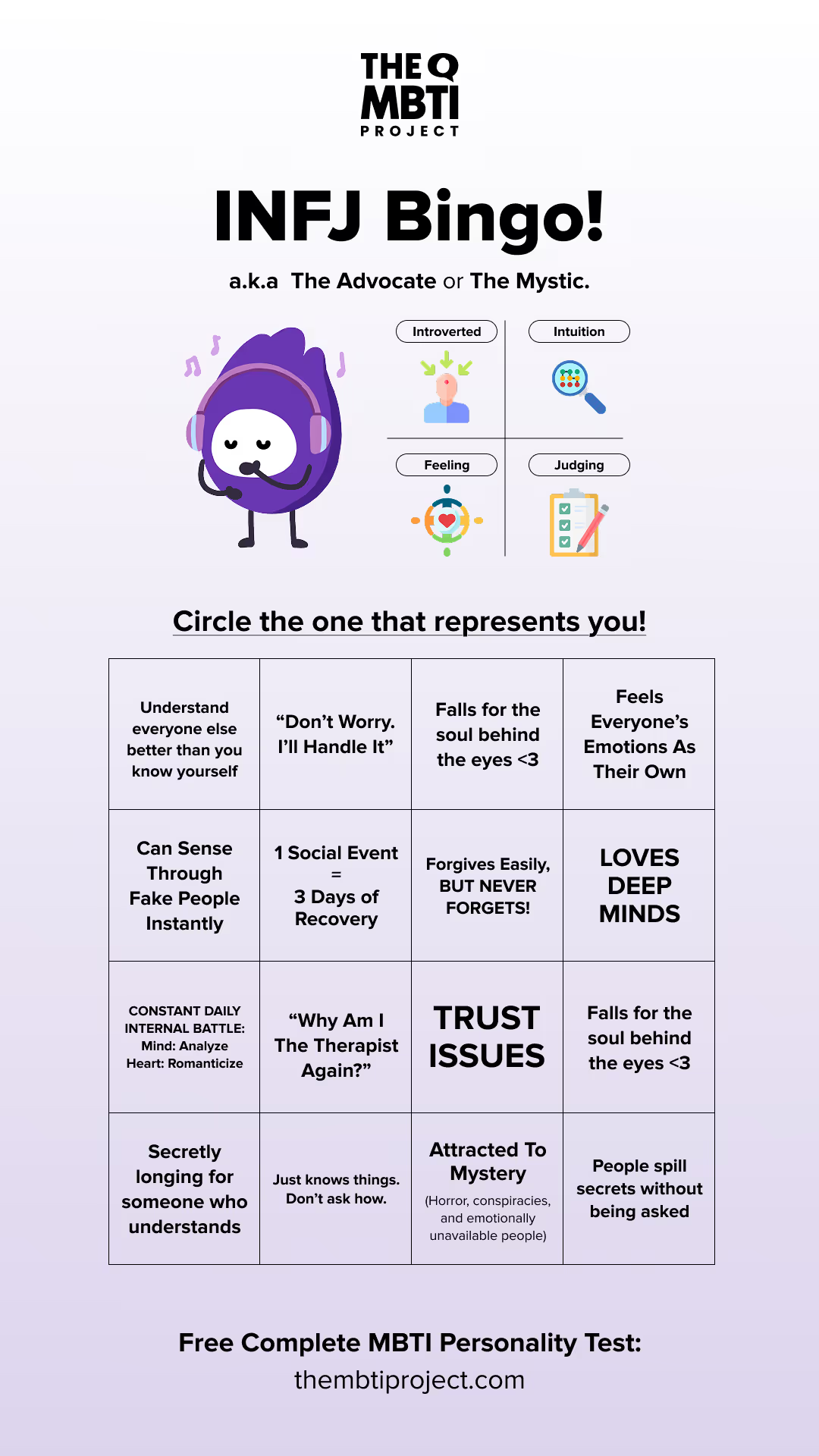
INFJ BINGO!

Think you’re a real INFJ?
Download this INFJ Bingo, mark your squares, and post it on your Stories! Don’t forget to tag @thembtiproject. We’ll feature the best ones!

Download INFJ Bingo

INFJ Introduction

INFJ is an Introverted (I), Intuitive (N), Feeling (F), and Judging (J) personality type that process life by synthesizing patterns and forming an internal vision of how people, relationships, or systems are likely to unfold.

INFJs are often called the Mystic because their insights often appear in symbolic realizations rather than practical explanations. They tend to “just know” when something is misaligned, especially in people or moral systems.

They’re also known as the Advocate because their intuitive insights are filtered through human values. INFJs often feel a natural compulsion to protect, guide, or improve the human condition. When their intuition detects injustice or emotional harm, they frequently feel responsible for speaking or acting on behalf of others.

Their strength lies in translating abstract insight into human-centered impact. When balanced, INFJs become powerful guides who help move people and systems toward deeper alignment and purpose.

UNFORTUNATELY ACCURATE:

INFJs can diagnose everyone else’s trauma, emotional patterns, and future life direction. Yet, remain unaware of their own unresolved feelings and basic physical needs.

Classic INFJ Lines:

“I don’t know how I know. I just know.”

“I can tell you’re not okay, even though you said you are.”

“Trust me. I’ve seen this pattern before.”

INFJ Strengths

1. Deep Pattern Recognition

INFJs detect abstract relational patterns and underlying meanings. They understand what’s happening beneath surface issues and where those dynamics are likely headed.

2. Human-Centered Insights

INFJs assess decisions by prioritizing human impact and consequences. They consider how outcomes will affect people emotionally, ethically, and relationally before anything else.

3. Strong & Strategic Internal Vision

INFJs can hold an internally guided vision of purpose without relying on external validation. They plan patiently, think several steps ahead, and act with intention rather than impulse.

4. Emotional Attunement

INFJs are highly sensitive to subtle emotional hints and unspoken tension in their surroundings. This makes them excellent at navigating complex interpersonal dynamics.

5. Moral Clarity

INFJs possess a strong internal sense of right and wrong that guides their decisions. They act with integrity, even when their values are unpopular or challenged by others.

6. Effective Guiding & Mentoring

While many people lead through control, INFJs guide others non-forcefully through insight and clarity. People often feel safe and understood as they are gently redirected.

Your MBTI Superpower!

Download our free 15-page guide to the most underrated strengths of the INFJs mind

INFJ Weaknesses

1. Emotional Self-Neglect

INFJs are so aware with other people's emotions that they often lose awareness of their own. They may ignore exhaustion, stress, or resentment until it overwhelms them.

2. Internal Rumination

INFJs' tendency to process everything internally can lead to mental and emotional congestion. They might continue analyzing events and conversations well past their relevance.

3. Idealism That Clashes with Reality

INFJs hold strong internal moral ideals of how people could grow or behave. When reality repeatedly fails to meet this, they may feel frustrated or quietly disappointed.

4. Difficulty Letting Go

INFJs consider carefully before committing. Once they decide, they invest fully, making it difficult to release people or responsibilities, even when doing so would be healthier.

INFJ Relationships

INFJ Communication Style

INFJs communicate with intention rather than volume. They tend to speak only after internally processing their thoughts, which makes their words feel deep and precise. Rather than thinking out loud, INFJs prefer to refine their ideas privately, then share them once they are internally coherent and aligned.

INFJs prefer conversations that explore patterns and meanings. They often steer dialogue toward why something matters, what it implies in the long-term, and how it affects other people. Also, because of their strong emotional sensitivity, INFJs adjust their tone and wording based on how others might receive the message.

Many INFJs express themselves more clearly in writing than in spontaneous speech. Writing gives them the space to organize complex thoughts without time pressure, resulting in messages that are more structured and coherent than their spoken conversations.

INFJ Compatibility With Other Personalities

INFJs tend to connect most naturally with personalities that appreciate emotional depth, purpose, and intentionality. This dynamic is often seen in their connection with INTJ, who also shares a preference for long-term clarity and vision (despite different emotional processing styles).

INFJs also frequently feel immediate resonance with ENFP and ENTP, whose curiosity and openness help INFJs externalize their inner insights and feel less isolated in their internal world. INFJ also often forms deep emotional bonds with INFP due to their shared introspection and strong inner values, resulting in relationships centered on authenticity and mutual understanding.

INFJs may struggle with personalities that prioritize immediacy, harsh logic, or constant external stimulation. They may struggle with ESTP and ESFP, whose more present-focused and fast-paced. With ESTJ or ENTJ, conflict may arise that stems from blunt communication and results-driven priorities over human considerations.

INFJ Main Need in Romantic Relationship

INFJs need emotional safety, value alignment, and intentional communication in relationships. They feel truly seen when their partner takes their inner world seriously and respects their need for reflection and depth. Consistency between words and actions is also essential for INFJ to trust, open up, and fully commit, as they seek relationships that are emotionally deep and purposeful.

INFJ Main Fear in Romantic Relationship

INFJs’ main fear in relationships is emotional disconnection that goes unnoticed or unaddressed. Because INFJs commit slowly but deeply, they fear becoming invested in a relationship where their values, emotions, or sense of purpose are neglected. When a relationship loses meaning and emotional authenticity, INFJs tend to withdraw, particularly if open and vulnerable communication is no longer available.

INFJ Relationship Blindspots

Blind spots are unnoticed patterns or habits that can create misunderstandings or emotional distance, even when no harm is intended.

BLINDSPOT #1

Expecting Depth At The Same Pace

INFJs move toward depth naturally and may expect their partner to do the same. When a partner needs more time to process emotions or decisions, INFJs may see it as a lack of care rather than a difference in needs.

BLINDSPOT #2

Over-Accommodating Without Boundaries

INFJs tend to supress their own emotional discomfort just to protect relational harmony and peace. By the time they express it, resentment may already be built internally.

BLINDSPOT #3

Idealizing Over Accepting Reality

INFJs may remain invested in who a partner could ideally become rather than who they consistently are. This can prolong emotional strain, especially in relationships that are no longer healthy.

INFJ Careers

INFJ Ideal Career Life

An ideal career for INFJs allows them to work in alignment with their sense of purpose, vision, and values. Their ideal environment provides space to think, reflect, and apply insight in a human-centered way. INFJs perform best when their work contributes to meaningful change, especially when they are able to guide others without being constrained by aggressive competition or strict procedures.

INFJ Career Stressors

INFJs experience career stress in environments that lack meaningful impact or ethical alignment. Constant urgency that prioritizes efficiency and metrics over human considerations quickly drains them, as it limits thoughtful and intentional processing. INFJs are especially stressed by emotionally detached environments that offer little quiet time for reflection. In such settings, they may disengage or burn out despite being highly capable and committed.

Best Career Paths for INFJ

Human Development & Psychological Fields

Examples: Counselor, Child Development, and Psychotherapist.
INFJs are naturally wired to understand people at a deep, internal level. They are able to see the deeper emotional patterns in life stories and behavioral cycles, while holding safe and reflective spaces for people to grow at their own pace.

Education, Mentorship & Teachings

Examples: Teacher, Curriculum Designer, Mentor, or Online Tutor.
INFJs perform best when teaching is rooted in purpose and human connection rather than mechanical delivery. They have a rare ability to connect ideas into coherent frameworks and adjust how those ideas are communicated based on the learner’s specific needs.

Research & Insight-Oriented Analysis

Examples: Social & Behavioral Research, Policy Analysis, UX Research.
This path fits INFJs because they excel at synthesizing complex systems, especially those involving people, culture, or long-term consequences. Research roles reward their patience, pattern recognition, and the ability to translate complex information into clear, meaningful insight.

Purpose-Driven Creative Communication

Examples: Book Writer, Documentary Filmmaker, or Illustrator.
INFJs are drawn to creative work when it expresses personal meaning and inner truth. Rather than creating for attention, they create to communicate values, invite reflection, and deepen understanding.

Advocacy & Human Impact Organizations

Examples: Community Development, NGO, or Social Impact Initiatives.
INFJs feel most energized when their work reflects their moral clarity. This field allows them to advocate for meaningful causes and guide communities in ways that align with their internal sense of right and wrong.

Healing, Wellness & Restorative Care

Examples: Holistic Healthcare, Nutritionist, or Spiritual Guide.
INFJs naturally recognize the interplay between emotional, mental, and physical wellbeing. They are attentive to subtle imbalances and gravitate toward holistic methods that address the person as a whole system, resulting in a more intentional and thoughtful approach to healing.

Careers to Avoid For INFJ

High-Pressure Sales & Persuasion Roles

Examples: Cold-Calling Sales, Telemarketer, or Comission-Only Sales.
INFJs dislike persuading people into decisions they don’t fully believe are right for them. Work that rewards sales tactics often conflict with their moral integrity. Even if successful, they may feel internally compromised.

Disorganized Sensory-Overloaded Work

Examples: Poorly Managed Warehouse, Logistics, or Nightclubs.
Roles that combine high physical demand with poor system, unpredictable flow, and constant sensory input can overwhelm INFJs over time. While they may cope during short bursts, prolonged exposure to chaotic, disorganized environments forces them into continuous reactive mode.

Superficial Social or Entertainment Roles

Examples: Hype-Driven Influencer, PR, or Spontanious Performer.
Jobs centered on attention or engagement seeking, without meaningful contribution tend to feel empty for INFJs. They lose motivation when authenticity is replaced by branding, performance, or spectacle.

Zero-Sum Competitive Environments

Examples: Corporate Ladder Cultures or Aggressive Law Firm.
Careers built on constant competition and politics tend to exhaust INFJs. When success depends on outmaneuvering others, prioritizing personal gain over shared good, INFJs feel internally conflicted and disengaged.

Real INFJ Examples

Real Human INFJ

Plato
(Greek Philosopher)

“Those who are able to see beyond the shadows and lies of their culture will never be understood, let alone believed, by the masses.”

“Love is the name for our pursuit of wholeness, for our desire to be complete.”

Benedict Cumberbatch
(English Actor)

“Because reading is one of the joys of life, and once you begin, you can’t stop, and you’ve got so many stories to look forward to.”

“You come into this world as you leave it, on your own. It’s made me want to live a life slightly less ordinary.”

Jane Goodall
(Primatologist)

“Every individual matters. Every individual has a role to play. Every individual makes a difference.”

“We don’t have to be perfect. But we do need to be intentional. The way we live sends a message to our children about what we believe in.”

Agatha Christie
(Writer / Novelist)

"One doesn't recognize the really important moments in one's life until it's too late."

"One of the luckiest things that can happen to you in life is to have a happy childhood."

Fictional INFJ Characters

Loki Laufeyson
(MCU Villain)

“I am Loki, of Asgard, and I am burdened with glorious purpose.”

“Love is a dagger. It’s a weapon to be wielded far away or up close. You can see yourself in it. It’s beautiful until it makes you bleed."

Armin Arlert
(Attack on Titan)

“I don't like the terms "good person" or "bad person" because it is impossible to be entirely good to everyone."

"A person who cannot sacrifice everything, cannot change anything."

Itachi Uchiha
(Naruto Shippuden)

"One’s reality might be another’s illusion. We all live inside our own fantasies."

“We don’t know what kind of people we truly are until the moment before our deaths. As death comes to embrace you, you will realize what you are.”

Joe Goldberg
(You - TV Series)

"Sometimes, we do bad things for the people we love. It doesn't mean it's right; it means love is more important."

"A book is far greater than most hands it passes through. Some simply aren't worthy."

Common INFJ Mistypes

1. INFP - Nara

Why INFJs mistype as INFPs:

  • Both are idealistic, introspective, and value-driven.
  • INFJs often speak about meaning and emotions, which many tests oversimplify as Fi dominance.

Key Differences:

  • INFJ (Ni Dom & Fe Aux): Focuses more on long-term direction and relational impact. Emotions are processed in relation to people and inner sense of purpose.
  • INFP (Fi Dom & Ne Aux): Focuses more on personal values and inner authenticity. Emotions are owned privately and protected strongly.
  • INFJs tend to prioritize long-term purpose and direction, while INFPs prioritize authenticity and inner value alignment.
See INFP's Profile
2. INTJ - Nova

Why INFJs mistype as INTJs:

  • Both are future-oriented, purposeful, and reserved.
  • INFJs can appear analytical and decisive once their vision is already clear (much like INTJs).
  • Many assessments mistakenly equate analytical thinking with Thinking dominance.

Key Differences:

  • INFJ (Ni Dom & Fe Aux): Decisions prioritize human impact, ethics, and relational consequences.
  • INTJ (Ni Dom & Te Aux): Decisions prioritize efficiency, logic, and objective outcomes.
  • INFJs adjust communication to emotional context, while INTJs prioritize clarity over emotional consideration.
See INTJ's Profile
3. ISFJ - Noki

Why INFJs mistype as ISFJs:

  • INFJ and ISFJ are both highly responsible and supportive.
  • Both use Extraverted Feeling (Fe), which makes them attentive to others’ needs.
  • In structured or traditional environments, INFJs may suppress abstract expression and adopt a more practical communication style.

Key Differences:

  • INFJ (Ni Dominant): Focuses on future patterns, meaning, and long-term implications.
  • ISFJ (Si Dominant): Focuses on past experience, reliability, and proven methods.
  • INFJs mostly ask “Where is this heading?” while ISFJs mostly ask “What has worked before?”
See ISFJ's Profile
Cognitive Functions Test

Specifically Designed to Navigate Mistypes

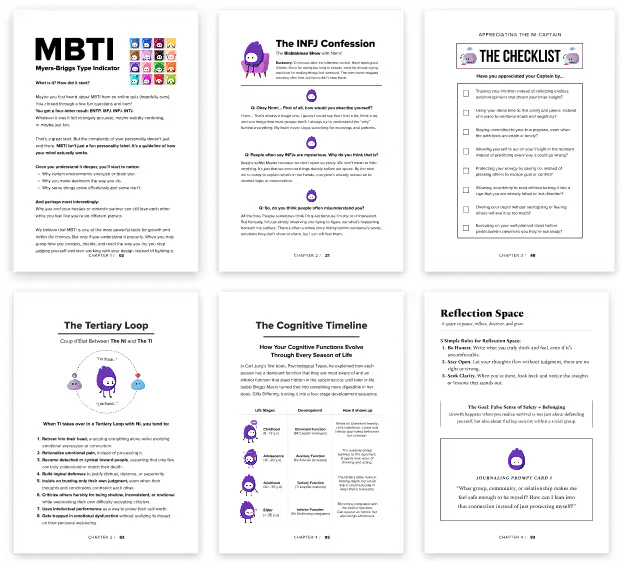
A Complete Self-Discovery Manual For An
INFJ

A Visual Self-Discovery Guide for INFJs Who Understand Everyone else, Yet Struggle to Understand Themselves.

Instant access • Visually Structured • Made Specifically for INFJ
Or See What’s Inside?
Thank You!
Your guide is on its way to your inbox.

Please check your email within the next 15 minutes. Don’t forget to check your spam or promotions folder just in case
Continue Exploring
Your Personalized [MBTI] Superpower Guide Is Ready!
We created a free illustrated guide to help you understand [MBTI]'s 5 best natural strengths. The guide will be sent to the email address you entered.
Thank You!
Your guide is on its way to your inbox.

Please check your email within the next 15 minutes. Don’t forget to check your spam or promotions folder just in case
Continue Exploring
Oops! Something went wrong while submitting the form.
------------------------------------------------------------------