Nino
THE ANALYZER
THE INVENTOR

INTP

The INTP personality type is characterized by analytical depth and a constant drive to understand the underlying principles behind systems, concepts, and ideas. As one of the 16 Myers-Briggs personality types, INTPs process information through internal logic and independent reasoning. They tend to refine their thoughts privately before sharing their conclusions with others in a carefully structured manner.

INTROVERTED
INTUITION
THINKING
PERCEIVING
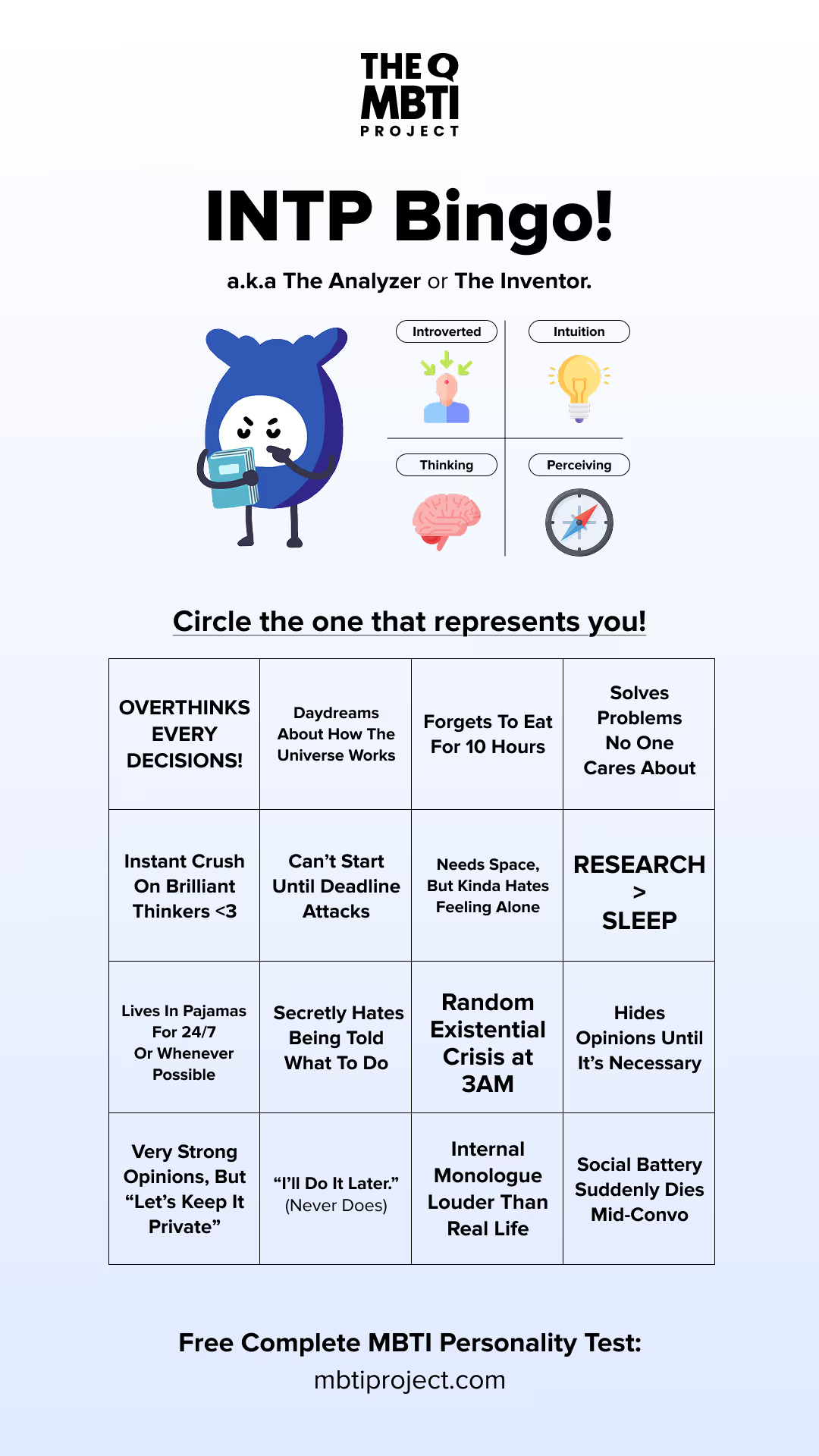
INTP BINGO!

Think you’re a real INTP?
Download this INTP Bingo, mark your squares, and post it on your Stories! Don’t forget to tag @thembtiproject. We’ll feature the best ones!

Download INTP Bingo

INTP Introduction

INTP is an Introverted (I), Intuitive (N), Thinking (T), and Perceiving (P) personality type, characterized by their analytical curiosity and desire for internal clarity.

INTPs are often called “The Analyzer” because they enjoy examining concepts deeply, questioning assumptions, and refining concepts until they feel internally coherent.

With a calm, independent approach to thinking, they bring depth, logical precision, and carefully reasoned perspectives.

UNFORTUNATELY ACCURATE:

INTPs can explain something perfectly in their head, then lose about 40% of the idea when saying it out loud.

Classic INTP Lines:

“So, technically...”

“I get what you’re saying, but something about it still doesn’t make sense.”

“Give me a second... I know what I mean, I just haven’t found the words.”

INTP Strengths

1. Deep Logical Analysis

INTPs naturally break ideas down into their underlying structure. They are patient in forming conclusions, focusing more on whether the reasoning itself is precise and consistent.

2. Intellectual Independence

INTPs prefer forming their own understanding over authority or consensus. They avoid adopting beliefs they haven’t personally examined, resulting in thoughtful, original perspectives.

3. Open-Ended Reasoning

INTPs are comfortable keeping ideas unfinished while they continue exploring them. They resist premature conclusions and stay willing to revise their thinking when better explanations emerge.

4. Explorative Curiosity

INTPs are driven by curiosity detached from recognition or immediate results. They enjoy following questions wherever they lead, often resulting in unexpected, deep insights.

5. Conceptual Clarity

INTPs seek clear mental frameworks that explain how things connect. When ideas are inconsistent, they feel a strong urge to refine them. They are able to simplify complexity without oversimplifying truth.

6. Calm Objectivity

INTPs are able to step back from emotional intensity and assess situations calmly. This makes them surprisingly steady in crises or conflicts where most people react impulsively.

Your MBTI Superpower!

Download our free 15-page guide to the most underrated strengths of the INTPs mind

INTP Weaknesses

1. Overthinking Paralysis

INTPs tend to keep refining instead of settling on a decision. When too many possibilities remain open, decision-making can stall. This often leads to delay, even when they understand the problem well.

2. Underdeveloped Emotional Awareness

INTPs often intellectualize emotions before fully processing them, which delays emotional clarity. This can cause confusion in relationships where immediate responses are expected.

3. Neglecting Practicality

Everyday tasks can feel draining or forgettable for INTPs, especially if they lack intellectual engagement. Over time, this can create practical issues and problems.

4. Difficulty Prioritizing

INTPs can see many angles at once, which makes it hard to decide what deserves attention first. When logic is still unresolved, everything can seem important, scattering their focus.

INTP Relationships

INTP Communication Style

INTPs communicate in a calm and thoughtful manner. They often taking time to organize their thoughts before speaking. INTPs enjoy thoughtful discussions where ideas can be explored clearly and without pressure.

INTPs may not speak often, but when they do, their words are carefully considered. They communicate with intention, listening while processing internally.

INTP Compatibility With Other Personalities

INTPs tend to be most compatible with personality types that respect their autonomy, value thoughtful discussion, and don’t pressure them to respond or decide too quickly. Types such as INTJ, INFP, ENTP, and ENFP often form natural connections with INTPs, where shared curiosity and engaging conversations can grow naturally.

INTPs are also frequently complemented by more outwardly structured or people-oriented types such as ENFJ, ESFJ, ENTJ, and ESTJ, who can provide emotional grounding and practical direction without overwhelming them.

Compatibility becomes more challenging with personalities that demand rigid routines and unquestioned authority, but maturity and mutual respect matter far more than personality type alone.

INTP Main Need in Romantic Relationship

INTPs need relationships that respect their personal space and pace. They value partners who communicate honestly and thoughtfully, without pressure or emotional rush. More than anything, INTPs need someone who sees the beauty in their curious mind and can celebrate their intellectual freedom without trying to cage it.

INTP Main Fear in Romantic Relationship

For INTPs, the biggest fear is being in a relationship where they slowly lose touch with who they are. They struggle when someone needs constant, immediate emotional reassurance while they’re still trying to understand their own feelings. When their need for space is mistaken for indifference, they begin to feel misunderstood instead of close.

INTP Relationship Blindspots

Blind spots are unnoticed patterns or habits that can create misunderstandings or emotional distance, even when no harm is intended.

BLINDSPOT #1

Asumming Silence = Understanding

INTPs sometimes believe that if something makes sense internally, it should eventually make sense to others. For their partner, this silence can feel like emotional withdrawal.

BLINDSPOT #2

Minimizing Non-Logical Needs

INTPs instinctively filter situations through logic and coherence. They may downplay or try to rationalize both their own emotions and their partner’s emotional needs.

BLINDSPOT #3

Fixing Instead of Validating

When conflict arises, INTPs naturally look for logical explanations or solutions. This can unintentionally skip over emotional validation, even when that’s what their partner needs most in the moment.

INTP Careers

INTP Ideal Career Life

INTPs do best in roles that give them room for problem-solving and idea exploration. An ideal career for an INTP allows flexible pacing and minimal micromanagement. The career offers opportunities to build and improve systems, while being evaluated on the quality of their thinking rather than sheer productivity or speed.

INTP Career Stressors

INTPs tend to feel stressed in careers that impose illogical rigid structures and  constant urgency without clear reasoning. Environments that demand emotional performance, repetitive tasks, or unquestioned compliance will drain them quickly. They also struggle when ideas are dismissed without discussion or when they’re pressured to act before they’ve had time to think things through.

Best Career Paths for INTP

Research & Analysis-Based Roles

Examples: Research Scientist, Data Analyst, or Systems Analyst.
INTPs thrive in careers centered on making sense of complex information. These roles reward depth of thinking, accuracy, and curiosity. Examples include research, policy analysis, academic work, or think-tank roles.

Technology & Engineering Careers

Examples: Software Engineer, Machine Learning, and Systems Architect.
INTPs are naturally driven by a need to fully understand how systems function at a structural level. Careers centered on building or improving systems align naturally with their strengths. These roles reward internal logic and independent problem-solving.

Product & Conceptual Design

Examples: Product Designer, UX Architect, and Game Design.
INTPs do well in roles that focus on how things work rather than how they look. Product thinking, UX strategy, and system design allow them to analyze user behaviors, improve logic flows, and refine user experiences through their iteration and reasoning capability.

Strategy & Problem-Solving Roles

Examples: Management Consultant or Business Strategy Analyst.
INTPs excel at seeing how parts connect within larger systems. Problem-solving or strategy roles (such as consulting) allow them to work on complex problems without being tied to daily operational pressure. These kinds of careers value insight more than constant execution.

Knowledge-Sharing Careers

Examples: University Lecturer, Technical Writer, or Curriculum Designer.
INTPs often enjoy explaining ideas once they fully understand them. Careers that involve writing, teaching, documentation, or even content creation allow them to organize thoughts clearly and communicate with precision, usually at their own pace.

Freelance or Self-Directed Careers

Examples: Freelance Programmer, Indie Game Developer, Consultant.
Freelancing, solo projects, research-based entrepreneurship, or flexible remote roles reduce micromanagement and allow them to follow curiosity while producing meaningful output. Many INTPs perform best when given autonomy over how and when they work.

Careers to Avoid For INTP

Highly Repetitive Roles

Examples: Data Entry Clerk, Admin Assistant, Assembly Line Operator.
Jobs centered on strict routines or constant, repetitive tasks quickly drain INTPs. When there’s little room to think, question, or improve systems, motivation drops fast. Over time, boredom turns into disengagement.

Micromanaged Authority-Driven Environments

Examples: Government Desk Officer or Traditional Banking Officer.
Careers that demand unquestioned obedience to rank or tradition are especially challenging for INTPs. They need reasoning behind decisions, not just instructions. Even highly capable INTPs may mentally disengage and become frustrated quickly in these environments.

Emotionally Demanding Customer-Facing Roles

Examples: Customer Support Agent, Receptionist, Hospitality Staff.
INTPs don’t lack empathy, but continuous emotional regulation, persuasion, or 'customer-service' friendliness can feel exhausting and overwhelming. They prefer meaningful explorative interaction over constant surface-level social engagement.

Roles Focused on Pressure and Urgency

Examples: Quota-Driven Sales Representative or Telemarketing Agent.
Careers that prioritize visibility and performance metrics (such as high-pressure sales roles) can be very draining for INTPs. These environments reward speed, persuasion, and self-promotion over insights. When success is only measured through constant output rather than thoughtful problem- solving, INTPs can feel undervalued despite being highly capable.

Real ENTP Examples

Real Human ENTP

Albert Einstein
(Inventor)

Questioned basic assumptions about space, time, and reality, refining ideas privately until they felt logically coherent.

Abraham Lincolyn
(Former U.S. President)

Known for his logical framing of moral and political issues, his leadership relied more on reasoning than emotional display or charisma.

Charles Darwin
(Theorist)

Slow, methodical approach to understanding complex systems. Spent decades refining his theories before sharing them publicly.

Marie Curie
(Scientist)

Independent and focused, her approach reflected patience, intellectual autonomy, and deep analytical thinking.

Fictional ENTP Characters

Sherlock Holmes
(Consulting Detective)

Intense internal analysis that prioritizes logical coherence over social norms. He often withdraws to think before acting.

Bruce Banner
(Scientist 'The Hulk')

Prefers quiet research, struggles with emotional expression, and withdraws when overwhelmed. Classic INTP inner-conflicts.

Shikamaru Nara
(Tactical Ninja)

Analyzes situations deeply and calmly before committing. Dislikes pressure and reluctance toward unnecessary action.

L
(Genius Detective)

Exemplifies INTP skepticism and open-ended reasoning. He holds multiple hypotheses at once and resists premature conclusions.

Common ENTP Mistypes

1. INTJ - Nova

Why INTPs mistype as INTJs:

  • Both types are analytical, introverted, and future-oriented, which makes their thinking style look similar on the surface.
  • INTPs can appear structured and decisive when their Dominant Ti reaches internal clarity, which resembles a key trait of INTJs.
  • Many tests equate strategic thinking with Judging, mistyping flexible thinkers such as INTPs as J-types.

Key Differences:

  • INTP (Ti Dom & Ne Aux): Seeks internal logical coherence and keeps ideas open for refinement.
  • INTJ (Ni Dom & Te Aux): Seeks a singular conclusion and moves toward direct execution.
  • INTPs resist premature closure, while INTJs seek it.
See INTJ's Profile
2. INFP - Nara

Why INTPs mistype as INFPs

  • Both lead with an introverted judging function (Ti vs Fi), giving them a reflective and reserved demeanor.
  • INTPs often discuss ethics or personal beliefs in a thoughtful way that resembles values-based reasoning (just like INFPs).
  • Many MBTI assessments oversimplify emotional sensitivity (which INTPs also have) and equate it with Feeling.

Key Differences:

  • INTP (Ti Dominant): Evaluates ideas by internal logical accuracy and consistency.
  • INFP (Fi Dominant): Evaluates ideas by personal values and emotional alignment.
  • INTPs revise beliefs when they no longer align with internal logic, while INFPs tend to strongly protect their core beliefs.
See INFP's Profile
3. ENTP - Nemo

Why INTPs mistype as ENTPs

  • Both types share strong Extraverted Intuition (Ne), bringing curiosity, idea exploration, and abstract thinking.
  • When energized, INTPs’ Ne becomes outwardly expressive, making them appear extraverted like ENTPs.

Key Differences:

  • INTP (Ti Dom & Ne Aux): Thinks internally first, then explores possibilities outwardly.
  • ENTP (Ne Dom & Ti Aux): Explores possibilities first, then evaluates them internally.
  • INTPs think before speaking. ENTPs think by speaking.
See ENTP's Profile
Cognitive Functions Test

Specifically Designed to Navigate Mistypes

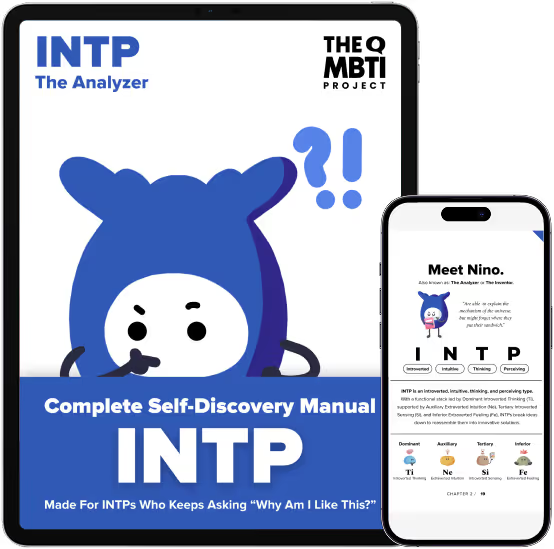
A Complete Self-Discovery Manual For An
INTP

A Visual Self-Discovery Guide for INTPs Who Want Deeper Self-Understanding Beyond What Logic Alone Can Explain.

Instant access • Visually Structured • Made Specifically for INTP
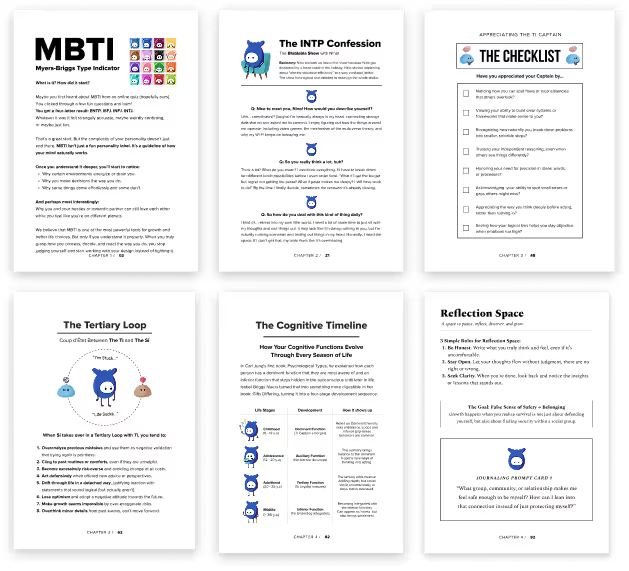
Or See What’s Inside?
Thank You!
Your guide is on its way to your inbox.

Please check your email within the next 15 minutes. Don’t forget to check your spam or promotions folder just in case
Continue Exploring
Your Personalized [MBTI] Superpower Guide Is Ready!
We created a free illustrated guide to help you understand [MBTI]'s 5 best natural strengths. The guide will be sent to the email address you entered.
Thank You!
Your guide is on its way to your inbox.

Please check your email within the next 15 minutes. Don’t forget to check your spam or promotions folder just in case
Continue Exploring
Oops! Something went wrong while submitting the form.
------------------------------------------------------------------