Navi
THE VIRTUOSO
THE CRAFTSMAN

ISTP

The ISTP personality type is characterized by analytical thinking and strong sensory awareness. As one of the 16 Myers-Briggs personality types, ISTPs process information through internal logic and immediate feedback from their environment. They figure things out through direct experience and experimentation in order to refine their practical approach and solutions over time.

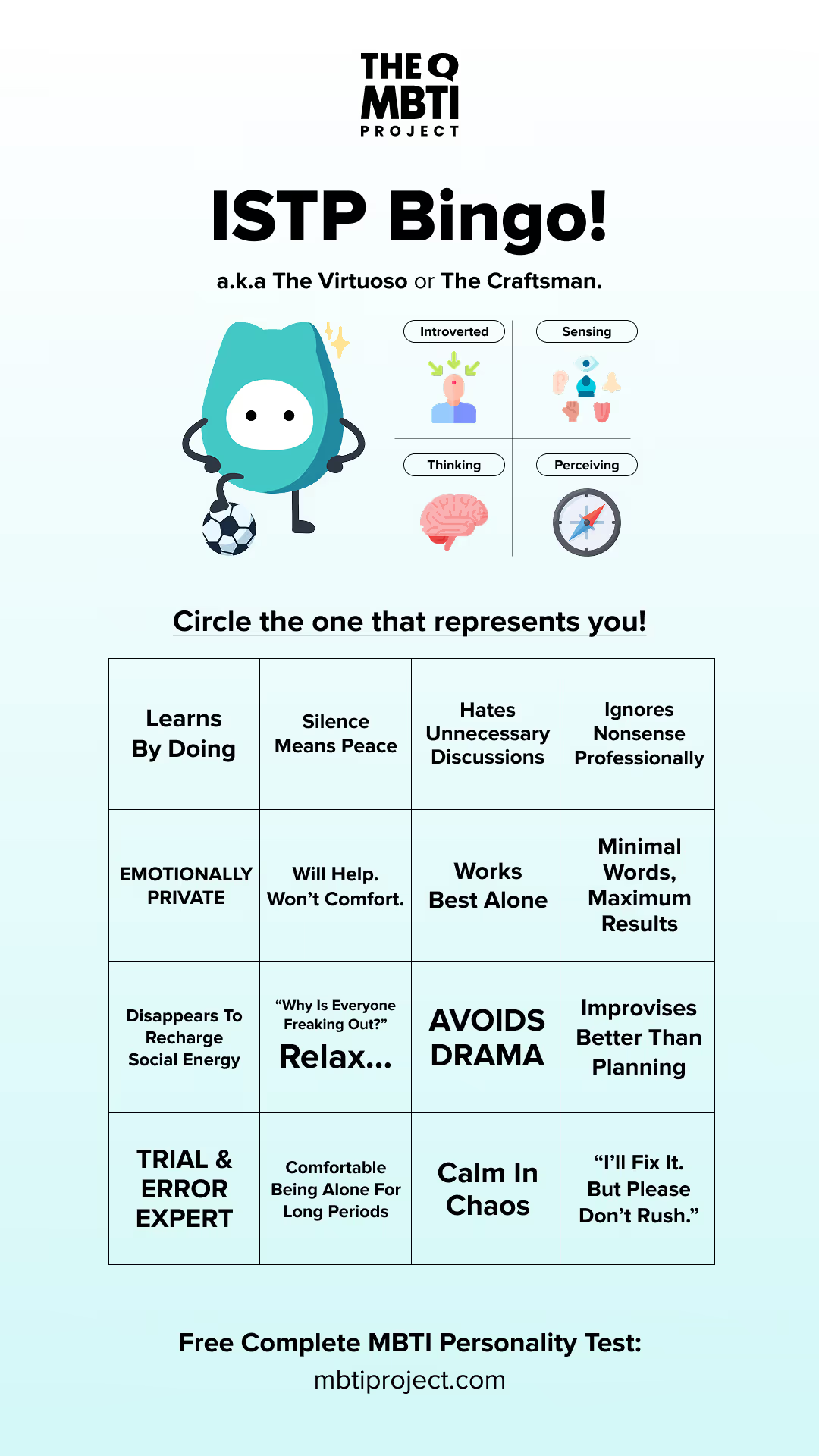
ISTP BINGO!

Think you’re a real ISTP?
Download this ISTP Bingo, mark your squares, and post it on your Stories! Don’t forget to tag @thembtiproject. We’ll feature the best ones!

Download ISTP Bingo

ISTP Introduction

ISTP is an Introverted (I), Sensing (S), Thinking (T), and Perceiving (P) personality type with a practical and independent approach to life.

ISTPs are called The Craftsman or The Virtuoso because they master things by focusing on technique, efficiency, and functional results. Once they commit to a skill, they usually refine it until it works reliably.

Instead of talking or overthinking through problems, they prefer to test, adjust, and see what works. Most ISTPs reach high levels of precision without needing attention or praise.

UNFORTUNATELY ACCURATE:

When ISTPs say “I’m fine,” they genuinely mean it. Unfortunately, this can leave the people closest to them wondering whether they’re still needed.

Classic ISTP Lines:

"I don’t need instructions. I'll figure it out."

"Less talk. More doing."

"I’ll fix it later. Please stop touching it."

ISTP Strengths

1. Calm Under Pressure

ISTPs tend to stay composed in situations that stress most people out. When something breaks, they immediately focus on what can be fixed right now with clear thinking.

2. Practical Problem Solving

ISTPs don’t solve problems in theory, they solve them in reality. They quickly identify what’s broken and inefficient, then fix only what actually matters.

3. Precise Internal Logic

ISTPs trust their own reasoning more than external noises or opinions. They care less about social pressures and more about what makes sense in practice.

4. Natural Self-Sufficiency

ISTPs are comfortable figuring things out on their own. They don’t need constant guidance and reassurance. This makes them highly adaptable in unfamiliar situations

5. Commitment to Skill Mastery

When ISTPs decide to learn a skill, they commit fully. They improve through repetition and hands-on experimentation that leads to mastery that stands on its own.

6. Simplifying Complexity

ISTPs naturally strip problems down to their essentials. They avoid unnecessary steps and excessive explanations. If there’s a cleaner, faster, or better way, they focus on that.

Your MBTI Superpower!

Download our free 15-page guide to the most underrated strengths of the ISTPs mind

ISTP Weaknesses

1. Emotionally Private

ISTPs tend to process emotions internally and quietly. Because they don't open up much, people around them may assume they’re distant, uninterested, or detached.

2. Can Seem Inconsistent

ISTPs can appear inconsistent in commitments involving others, even when they’re personally dedicated to growth. This can be misunderstood as a lack of follow-through.

3. Low Tolerance for Impracticality

ISTPs lose patience quickly when things feel slow or overcomplicated. When progress stalls, they may disengage from progress without communicating their concerns.

4. Avoids Vulnerable Conversations

ISTPs often withdraw when discussions become emotionally heavy. Conversations without a clear solution and end-result can feel unnecessary for them.

ISTP Relationships

ISTP Communication Style

ISTPs typically communicate concisely and minimally. Because much of their thinking happens internally, they may speak only after they have processed a situation thoroughly and reached a clear conclusion. This can make them appear quiet or uninterested, even when they are fully engaged.

ISTPs bond mostly through shared experiences rather than long conversations.
They feel closest to others when working side by side, spending time doing something together. When they have decided to trust someone, they show care through presence and practical action rather than expressive emotional display.

ISTP Compatibility With Other Personalities

ISTPs connect most easily with types who are practical and grounded. Types like ISFJ or ESFJ often work well with them because both value reliability and practical responsibility. Similarly, ISTPs also connect well with types who prioritize problem-solving over unnecessary complexity, such as INTJ, forming connection built on mutual respect and competence.

ISTPs tend to find relationships more challenging with types who rely heavily on emotional expression and constant communication. For example, ENFPs or INFJs may create friction because they seek emotional clarity and meaning through abstract conversation, while ISTPs prefer space and simplicity. These differences require mutual understanding to work well.

ISTP Main Need in Romantic Relationship

ISTPs’ main need in a relationship is freedom, complemented with trust. They need the autonomy to think, act, and grow without emotional pressure, while knowing the relationship remains stable and respected. ISTPs feel most connected when their independence is honored and communication is honest, clear, and low-drama.

ISTP Main Fear in Romantic Relationship

ISTPs’ main relationship fear is losing autonomy. They fear being trapped in constant emotional demands or expectations that limit their ability to act independently. When a relationship feels overly controlling or demanding, ISTPs may withdraw to protect their independence and stay grounded in themselves.

ISTP Relationship Blindspots

Blind spots are unnoticed patterns or habits that can create misunderstandings or emotional distance, even when no harm is intended.

BLINDSPOT #1

Assuming Silence = Stability

ISTPs tend to assume that if nothing seems wrong on the surface, the relationship is fine. What feels peaceful to the ISTP may feel distant to their partner.

BLINDSPOT #2

Withdrawing Without Explaning

When overwhelmed, ISTPs often withdraw to restore their calm. This helps them reset internally, but it may leave their partner feeling confused or excluded.

BLINDSPOT #3

Ignoring Partner's Love Needs

ISTPs naturally express care through practical support, rather than words. Partners who value emotional expression may not recognize these actions as affection.

ISTP Careers

ISTP Ideal Career Life

The ideal career life for ISTPs is one that offers autonomy, hands-on problem-solving, and clear impact. ISTPs love roles where they can work independently and improve systems through direct action rather than prolonged discussion. They perform best in environments where results matter more than politics and their pursuit of competence is apreciated. Careers that allow ISTPs to build skills and see meaningful outcomes from that skill tend to keep them engaged and satisfied over the long term.

ISTP Career Stressors

Roles with excessive meetings, restricting procedures, and constant supervision can quickly drain them, especially when meaningless discussion replaces action. They also struggle in workplaces with unclear expectations or heavy emotional pressure. When their ability to act, improve, and optimize is hindered, ISTPs may disengage from the role entirely.

Best Career Paths for ISTP

Technical & Mechanical Roles

Examples: Engineer, mechanic, technician, and machinist.
ISTPs excel in roles that involve understanding systems and fixing what’s broken within them. These careers let them troubleshoot, work with tools, and improve efficiency through their practical problem-solving.

Skilled Trades & Craft-Based Work

Examples: Electrician, welder, carpenter, and toolmaker.
Skilled trades suit ISTPs because the mastery of the skill needed is built through repetition, technique, and feedback. Progress is directly visible and competence matters more than titles.

Emergency & Tactical Fields

Examples: Firefighter, paramedic, search-and-rescue, military units.
ISTPs perform exceptionally well under pressure while remaining calm. These roles require clear-headed decision-making and decisive action, exactly where ISTPs’ ability to stay grounded shines.

Technology & Applied IT

Examples: Technical support, cybersecurity, hardware specialist.
These roles allow ISTPs to diagnose problems and optimize systems, while working independently. Success on these careers depends on precise solutions and real tangible outcomes.

Hands-On Creative & Technical Design

Examples: Industrial designer, product designer, and sound engineer.
These careers balance creativity with practicality, allowing ISTPs to create things that function well through constant testing, refinement, and technical competence.

Independent & Freelance Work

Examples: Freelance technician, consultant, and solo entrepreneur.
Autonomy is an essential driver for ISTPs. Independent work, such as freelancing, allows them to set rules for themselves and control their workflow while continuously improving their skill set.

Careers to Avoid For ISTP

Highly Bureaucratic Corporate Roles

Examples: Corporate administration, compliance, policy management.
These roles prioritize procedures, approvals, and meetings over continuous progress. ISTPs quickly feel drained when their daily work depends more on paperwork and hierarchy than practical results.

Non-Applicative Long-Term Research

Examples: Pure theoritical academic research.
Careers focused on abstract thinking without real-world application over long periods can leave ISTPs feeling disconnected and demotivated, given their hands-on nature.

Emotionally Demanding Support Roles

Examples: Full-time counseling, HR mediation, customer service.
Although ISTPs are capable of caring deeply, roles that demand constant emotional processing and outward empathy can be draining. When emotional labor isn’t balanced with practical result, burnout comes quickly.

Sales Roles Built on Persuasion Over Product

Examples: Cold sales, relationship-heavy sales, upselling roles.
ISTPs are comfortable understanding and clearly explaining products, even when they are complex. However, they dislike emotional persuasion or selling ideas they don’t fully believe in from a technical standpoint.

Real ISTP Examples

Real Human ISTP

Bruce Lee
(Martial Artist)

"Absorb what is useful, Discard what is not, Add what is uniquely your own."

"I fear not the man who has practiced 10,000 kicks once, but I fear the man who has practiced one kick 10,000 times."

Clint Eastwood
(Film Actor)

"Respect your efforts, respect yourself. Self-respect leads to self-discipline. When you have both firmly under your belt, that's real power."

"Sometimes if you want to see a change for the better, you have to take things into your own hands."

Michael Jordan
(Basketball Legend)

"I've missed more than 9000 shots in my career. I've lost almost 300 games. 26 times, I've been trusted to take the game winning shot and missed. I've failed over and over and over again in my life. And that is why I succeed"

"Talent wins games, but teamwork and intelligence wins championships."

Kristen Stewart
(Film Actress)

"You have to be OK with your own fears. If you're an honest person, you'll make mistakes, but that's when the most interesting things happen."

"I'm not sure if I'm most happy when I'm comfortable and content or when I'm pushing myself to the limits. There are such different versions of happy, and I really appreciate both."

Fictional ISTP Characters

Arya Stark
(Games of Thrones)

"Nothing isn't better or worse than anything. Nothing is just nothing."

"A bruise is a lesson and each lesson makes us better"

Roronoa Zoro
(One Piece)

“You need to accept the fact that you’re not the best and have all the will to strive to be better than anyone you face.”

"I don't care what the society says. I've never regretted doing anything. I will survive and do what I want to."

Indiana Jones
(Indiana Jones)

"You don't have to get sore all the time just to prove how tough you are"

"It's not the years, honey. It's the mileage"

Levi Ackerman
(Attack on Titan)

"The only thing we’re allowed to do is believe that we won’t regret the choice we made."

"The difference between your decision and ours is experience. But you don't have to rely on that. Choose."

Common ISTP Mistypes

1. ISTJ - Nilo

Why ISTPs mistype as ISTJs:

  • Both are introverted, practical, and focused on practical functionality.
  • ISTPs under stress can start to become more rigid or rule-following, which resembles ISTJ behavior.

Key Differences:

  • ISTP (Ti Dom & Se Aux): Adapts on the spot, changes methods if something works better.
  • ISTJ (Si Dom & Te Aux): Relies on proven procedures and consistency over improvisation.
  • ISTPs prefer improvisation, while ISTJs depend on structure and reliability.
See ISTJ's Profile
2. ESTP - Nion

Why ISTPs mistype as ESTPs:

  • Both are action-oriented, hands-on, and decisive under pressure.
  • Confident ISTPs in familiar environments can look socially bold, just like ESTPs.
  • Shared Se (Extraverted Sensing) makes both appear grounded, practical, and fast-reacting.

Key Differences:

  • ISTP (Ti Dom & Se Aux): Acts after internal analysis. Prefers independence and minimal social engagement.
  • ESTP (Se Dom & Ti Aux): Acts first, thinks while moving. Energized by social interaction and external stimulation.
  • ISTPs conserve internal space and social energy. ESTPs seek external stimulation and engagement.
See ESTP's Profile
3. INTP - Nino

Why ISTPs mistype as INTPs:

  • Both lead with Ti (Introverted Thinking) dominant and value internal logic over social norms.
  • ISTPs in 'analysis' mode can appear detached, just like INTPs
  • Most MBTI tests focus only on logical orientation without considering where the insight actually comes from.

Key Differences:

  • ISTP (Se Auxiliary): Thinking is refined through interaction with reality.
  • INTP (Ne Auxiliary): Thinking is refined through mental and concept exploration.
  • ISTPs trust logic that works in practice. INTPs trust conceptual logic consistency.
See INTP's Profile
Cognitive Functions Test

Specifically Designed to Navigate Mistypes

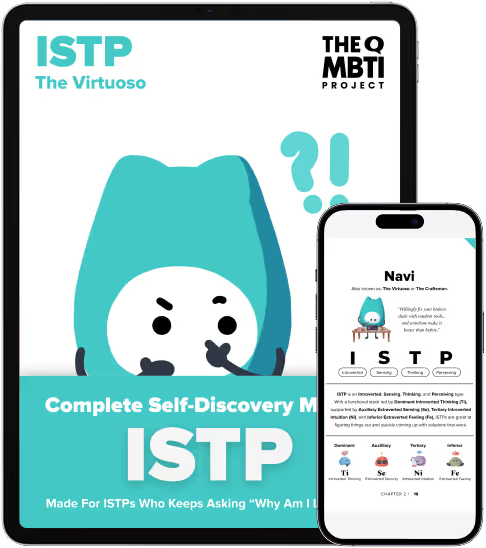
A Complete Self-Discovery Manual For An
ISTP

A Visual Self-Discovery Guide for ESTPs Who Solve External Problems Easily But Rarely Look Deeper Inward.

Instant access • Visually Structured • Made Specifically for ISTP
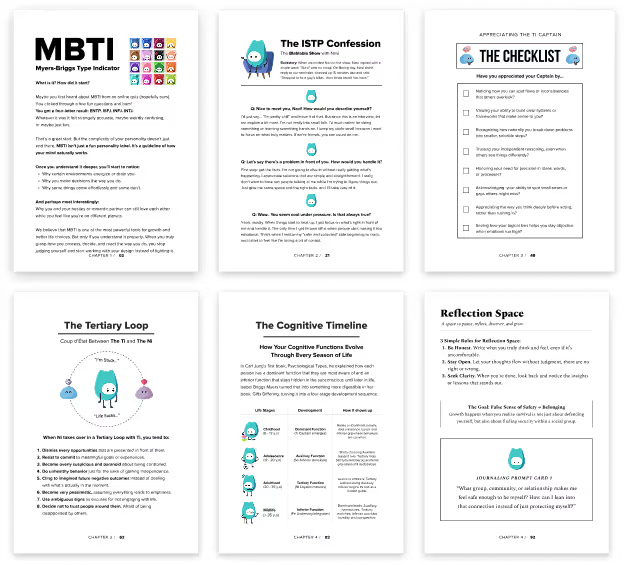
Or See What’s Inside?
Thank You!
Your guide is on its way to your inbox.

Please check your email within the next 15 minutes. Don’t forget to check your spam or promotions folder just in case
Continue Exploring
Your Personalized [MBTI] Superpower Guide Is Ready!
We created a free illustrated guide to help you understand [MBTI]'s 5 best natural strengths. The guide will be sent to the email address you entered.
Thank You!
Your guide is on its way to your inbox.

Please check your email within the next 15 minutes. Don’t forget to check your spam or promotions folder just in case
Continue Exploring
Oops! Something went wrong while submitting the form.
------------------------------------------------------------------