
ENTPs are curious and quick-witted explorer of ideas that constantly brainstorming and challenging norms. They love mental sparring and see possibilities where others see problems.
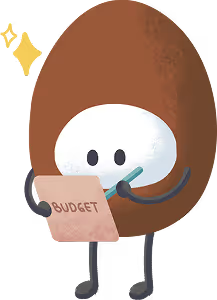
ISTJs are reliable forces who value structure and doing things the right way. They approach life with a sense of responsibility and strong determination to follow through on their commitments.

ISFPs are gentle souls who are guided by deep feelings and a strong sense of personal aesthetics. They express themselves through actions, creativity, and the beauty they bring to the world.

ISTPs are cool, composed problem-solvers who thrive on hands-on action and practical logic. Independent and observant, ISTPs have a natural knack for understanding how things work.

INTPs are powerhouses of intellect and curiosity. They analyze and rebuild ideas in pursuit of truth. INTPs like to solve complex problem and question everything from systems to social norms.

INFPs are idealistic and emotionally rich souls, guided by a strong inner compass. They are imaginative, compassionate, and often drawn to creative expression or helping others heal.

INFJs are intuitive visionaries who blends insight with empathy. They have a rich inner world, sensing the emotional currents around them and yearning to make a meaningful impact.

INTJs are visionary thinkers with a blend of logic, independence, and long-term focus. They excel at spotting patterns and constructing systems that move ideas from theory to reality.

ISFJs are gentle guardians with a heart for service and a respect for tradition. They notice the needs of others before their own and often go above and beyond to create comfort and stability.
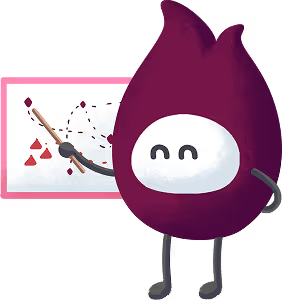
ENTJs are natural-born leaders with a sharp mind and relentless drive to turn ideas into action. They organize chaos with ease and inspire others to level up through their commanding presence.

ENFPs are warm and imaginative souls bursting with enthusiasm for life. Driven by deep curiosity, ENFPs are able to see hidden potentials everywhere, especially in others.

ESTPs are bold, action-oriented thrill-seekers who live for the here and now. Sharp and charming, they are quick to read a room, spot an opportunity, and dive headfirst into experience.

ESFPs are fun-loving and spontaneous performers with a gift for making others feel seen and celebrated. They thrive on connection and experiences, often lighting up any room they walk into.

ESTJs are natural leaders who thrive on structure and responsibility. Grounded in logic and tradition, they take charge and bring order to chaos through efficient planning and action.

ENFJs are charismatic guides with a heart full of purpose and a vision for growth. They have a natural talent for understanding people and inspiring them toward their highest potential.

ESFJs are dependable individuals who thrive on creating harmony and making others feel valued. They’re really good at nurturing relationships and stepping up when someone needs support.
Heads Up!
Your result is not stored online — it’s only saved in this browser.
Please download your PDF now to keep the result.
CONFIDENCE LEVEL: HIGH
One sentence explanation about the confidence level.

















Your top scoring MBTI type ([Rank 1]) matches your dichotomy result ([Dichotomy Type]). This gives a high confidence level that [Rank 1] is your most accurate type.
Your functional pattern and your preference letters are aligned.
Your self-perception and psychological structure are consistent.
Mistyping likelihood: Low.
→ Explore the depth of [Rank 1]
Your dichotomy result ([Dichotomy Type]) matches your Rank 2 ([Rank 2]) instead of Rank 1 ([Rank1]). This indicates moderate confidence, with a possibility of mistyping between [Rank 1] and [Rank 2].
You may:
Relate to core traits of [Rank 1], but externally behave like [Rank 2].
Show adaptation from environment, social role, or conditioning.
Switch depending on stress vs comfort zones.
→ Compare the two types. It’s worth exploring the differences more deeply.
Your dichotomy result matches Rank 3 ([Rank 3]), which means there is significant mistype complexity.
You may be adapting strongly in certain environments.
Your real internal process may differ from how you present externally.
Your test result may reflect your adapted personality, not your natural one.
→ Reflect on which type feels like the real you, especially in private vs public settings.
None of your top 3 cognitive-based type rankings match the dichotomy letters. This indicates a high mistype probability or strong internal conflict between self-perception and functional reality.
Your test responses may reflect adaptation, masking, or environment-driven behaviors.
You might be identifying with a type you want to be, not who you naturally are.
You could be in transition phase affecting your responses.
→ Explore your Rank 1–3 types deeply. This is a valuable opportunity for deeper self-discovery. Also, it is important to start re-evaluating identity beyond the letter stereotypes.
These scores show how strongly you lean toward each of the four core MBTI preferences based on your responses.








According to your letter preference pattern, your MBTI type appears to lean toward [dich-types], but we’ll compare this with your 8 cognitive function scoring to ensure accuracy.
These scores show how strongly you use each of the eight Jungian cognitive functions in your decision-making and perception. Think of these as the “mental engines” powering your MBTI personality.








These scores estimate how strongly your cognitive pattern aligns with each of the 16 MBTI types using two scientific scoring models.


Choose how you want to continue your self-exploration journey

Explore a full breakdown of the ENTP personality, including strengths, blindspots, career life, relationships, and mistypes.

Explore a full breakdown of the ENFP personality, including strengths, blindspots, career life, relationships, and mistypes.

Explore a full breakdown of the INTP personality, including strengths, blindspots, career life, relationships, and mistypes.

Explore a full breakdown of the INFP personality, including strengths, blindspots, career life, relationships, and mistypes.

Explore a full breakdown of the ESTP personality, including strengths, blindspots, career life, relationships, and mistypes.

Explore a full breakdown of the ESTP personality, including strengths, blindspots, career life, relationships, and mistypes.

Explore a full breakdown of the ISTP personality, including strengths, blindspots, career life, relationships, and mistypes.

Explore a full breakdown of the ISFP personality, including strengths, blindspots, career life, relationships, and mistypes.

Explore a full breakdown of the ENTJ personality, including strengths, blindspots, career life, relationships, and mistypes.

Explore a full breakdown of the ENFJ personality, including strengths, blindspots, career life, relationships, and mistypes.

Explore a full breakdown of the INTJ personality, including strengths, blindspots, career life, relationships, and mistypes.

Explore a full breakdown of the INFJ personality, including strengths, blindspots, career life, relationships, and mistypes.

Explore a full breakdown of the ESTJ personality, including strengths, blindspots, career life, relationships, and mistypes.

Explore a full breakdown of the ESFJ personality, including strengths, blindspots, career life, relationships, and mistypes.

Explore a full breakdown of the ISTJ personality, including strengths, blindspots, career life, relationships, and mistypes.

Explore a full breakdown of the ISFJ personality, including strengths, blindspots, career life, relationships, and mistypes.
